Why this matters
Neural Lyapunov certification of multi-machine power grids has been stuck near a small handful of generators because sound branch-and-bound verification is exponential in state dimension. This work shows the exponential wall is a composition problem, not a fundamental verification limit: splitting the grid into per-generator subsystems and composing local certificates with a single linear-algebra coupling test turns exponential cost into low-order polynomial cost — while the thing that actually caps how much of the true region gets certified is a specific, diagnosable obstruction (lossy coupling has no scalar potential), not the compositional machinery itself.
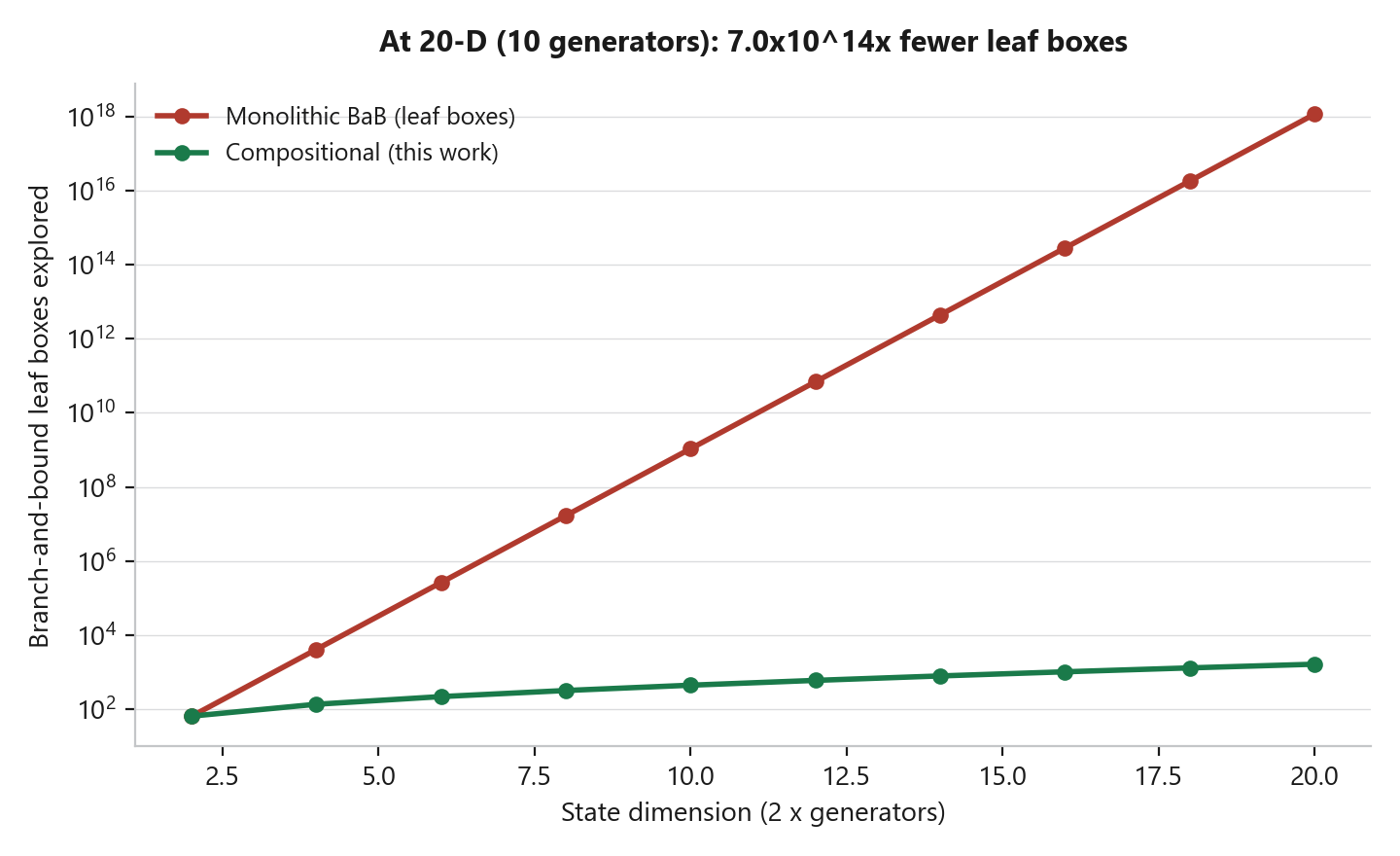
Monolithic BaB explores 1.15×10¹⁵ leaf boxes at the full 20-D (10-generator) system; the compositional certificate explores 1,640 — a measured 7.0×10¹⁴× reduction, with sound decentralized composition throughout.
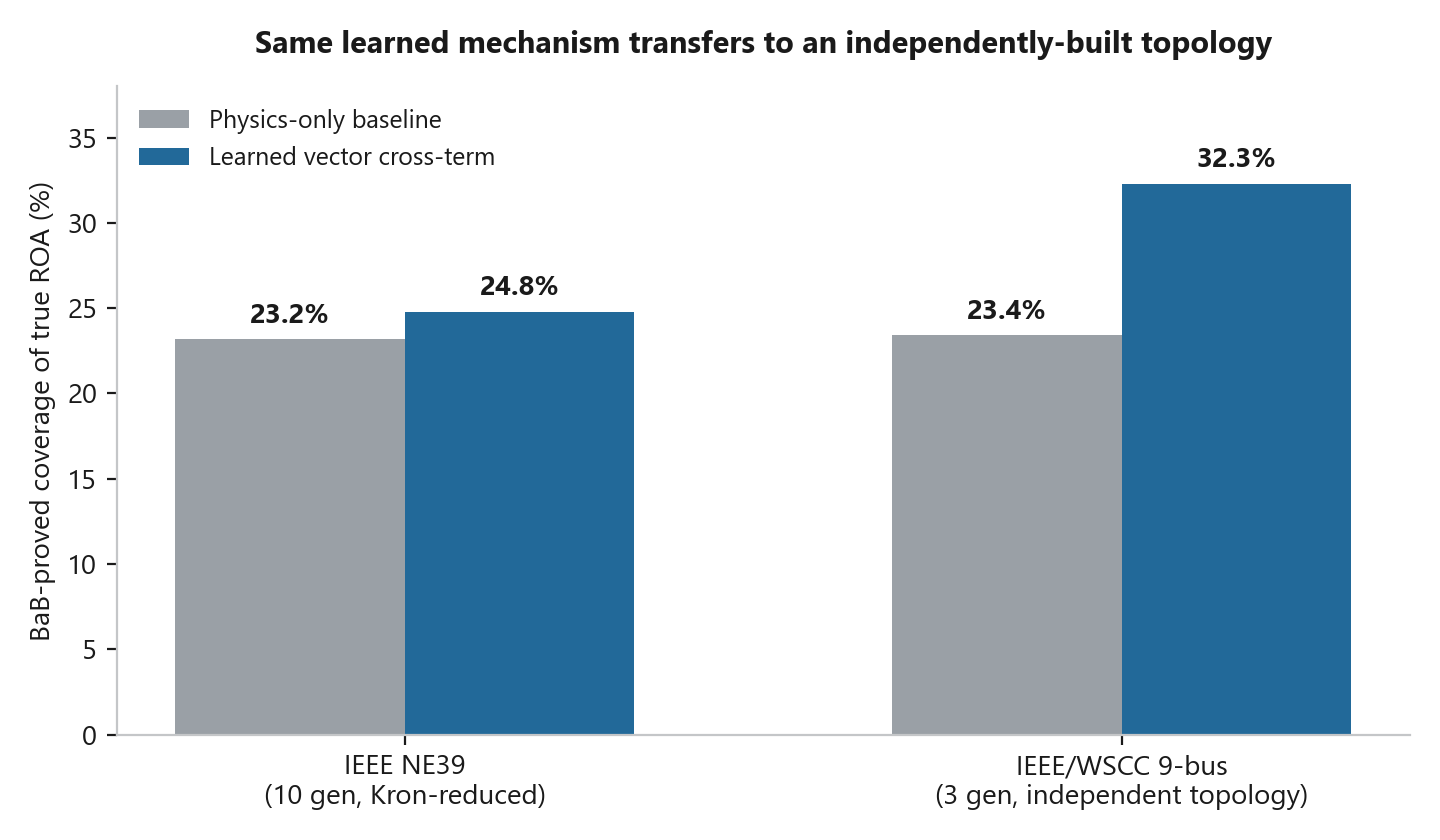
The same learned vector cross term, trained once and reused unchanged, improves coverage on a second, independently-built topology (IEEE/WSCC 9-bus, 3 machines) by +38% relative — a larger gain than on the original 39-bus system.
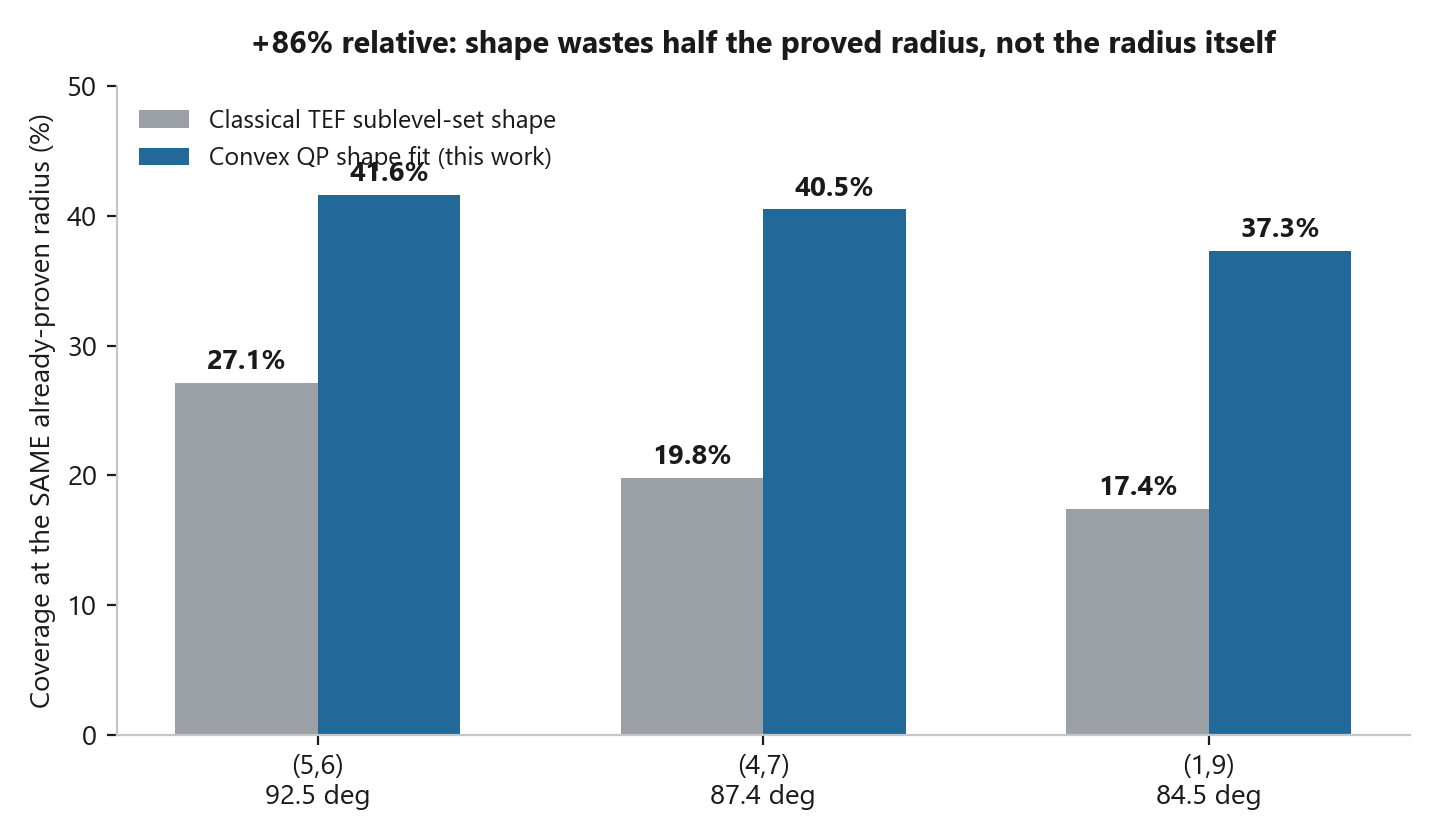
At the exact same already-proven radius, a single convex QP shape fit recovers +86% relative coverage over the classical TEF sublevel-set shape — a gain six independent gradient-based searches never found, because they optimized radius and shape jointly.
Headline result: physics baseline vs. learned cross term
100% soundness on every slice reported (0 certified-unstable points), dense Monte Carlo ground truth.
| System | Generators | Physics-only coverage | Learned coverage | Relative gain |
|---|---|---|---|---|
| IEEE New England 39-bus | 10 (Kron-reduced) | 23.2% | 24.8% | +7% |
| IEEE/WSCC 9-bus | 3 (independent topology) | 23.4% | 32.3% | +38% |
Independent cross-check: interval BaB vs. exact sum-of-squares
SOS certificate implemented independently from the interval-BaB verifier, run on the same polynomial.
| Verifier | Mean coverage (3 slices) | Contradictions |
|---|---|---|
| Interval branch-and-bound | 22.0% | — |
| Exact sum-of-squares (Positivstellensatz) | 22.0% | 0 |
Side exploration: how far does a genuinely different verifier scale?
Independently of the compositional/BaB line above, we tested whether CROWN-based certified training — a linear-relaxation bound-propagation verifier, fundamentally different from interval BaB — could hold a fixed local Lyapunov certificate as the number of generators included in a joint slice grows, reusing an existing, previously-validated CROWN pipeline unchanged. This is a different question from the coverage numbers above (a local certified box radius in normalized coordinates, not a fraction of the true ROA), reported here for completeness and honesty about what did and did not scale.
| Slice dimension | Generators | Certified ρ (headline) | Independent cross-check ρ |
|---|---|---|---|
| 4-D | 2 | 2.5 | — |
| 6-D | 3 | 2.5 | 1.0 (partial gap) |
| 8-D | 4 | 2.5 | 2.5 (full agreement) |
| 10-D | 5 | 2.0 (dropped) | 1.5 |
What did not work
Six independently designed architecture searches on the radius sub-problem — scalar residuals, alternative parameterizations, global fields, joint shape+radius training among them — all converged on the same 93–106° ceiling for this certificate family, regardless of verifier (interval BaB, SOS, adversarial search, or a zero-relaxation oracle). A margin-floor training run that pushed structural LMI margins toward 100% of the physics baseline did not cost coverage as expected; it mildly improved it. The trained field is robust to a ±15% loading perturbation on two of three evaluation slices and collapses to 0° on the third — reported as a genuine mixed result, not smoothed into a single robustness claim. None of this is hidden in the writeup: eight independently designed negative results are reported in full as part of the paper's central contribution, not filtered out.