A certificate C is a bound: C(f) ≥ T(f) for every design f in a parametric family, where T is the true objective. Certificates are used not only to verify designs but to optimise over them — choosing the AMG preconditioner with the lowest certified bound, training the network with the highest certified accuracy, selecting the certified-optimal design. That use presupposes rank fidelity: the certificate's ranking of designs matches the truth's ranking. It need not. The slack S = C − T varies across the family, and when it does, the certificate can rank designs wrongly — even anti-rank them, as we measure for physics-informed neural networks (\\(\\rho_S = -0.96\\)). We prove the answer is governed by a single dimensionless quantity, the slack ratio \\(r = \\mathrm{Var}(S)/\\mathrm{Var}(T)\\), with a sharp phase transition at \\(r \\approx 1\\): for \\(r \\le 1\\) rank fidelity is perfect; for \\(r > 1\\) it degrades predictably as \\(\\rho_S \\sim g(r) = 1 - \\alpha\\,\\mathrm{ReLU}(\\tanh(\\beta \\ln r))\\). We validate across eight domains — algebraic multigrid, polynomial interval analysis, certified neural robustness, PINNs, HPC-scale 3D Navier–Stokes AMG, and a real free-boundary Grad-Shafranov tokamak equilibrium solver — and release an open-source diagnostic that determines, before any optimisation begins, whether a certificate can be trusted.
Eight domains, one phase transition
Every claim below traces to a committed JSON in results/. The CIFAR-10 row is the verified experiment run on Kaggle (kernel rank-fidelity-cpu-v10): 52 MLPs, certified accuracy by exact interval bound propagation, robust accuracy by 10-step PGD, \\(\\epsilon = 8/255\\).
| Domain | \\(\\rho_S\\) (obs) | \\(p\\) | Regime |
|---|---|---|---|
| AMG scalar | 1.000 | <10−16 | safe |
| AMG diagonal | 0.55–0.77 | <10−7 | transition |
| Polynomial interval | 0.531 | 7×10⁻⁵ | transition |
| Linear IBP | 0.585 | 7×10⁻³ | transition |
| PINN Burgers | −0.959 | <10−4 | anti-ranked |
| 3D NS AMG (HPC, 128³) | 0.38 | 0.23 | overflow |
| MLP CIFAR-10 | 0.368 | 0.007 | transition |
| Tokamak (real GS) | 0.993 | <10−10 | safe |
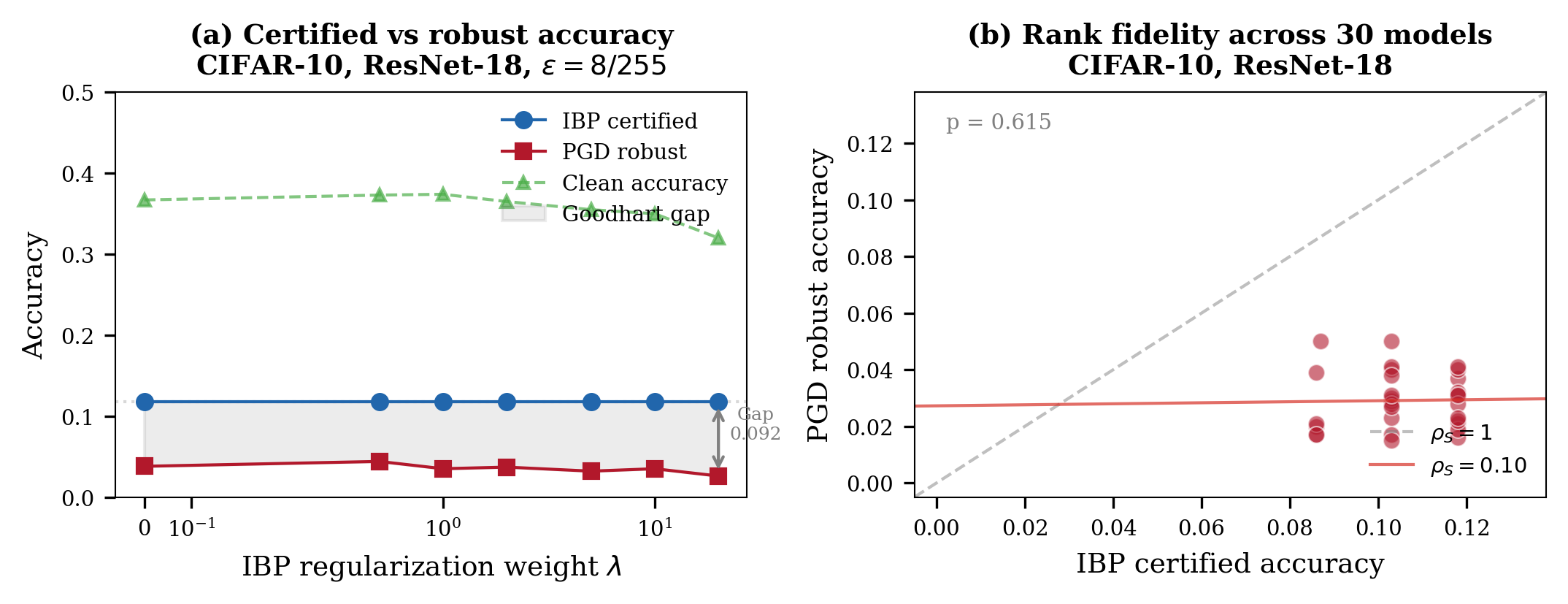
Certified accuracy rises with IBP regularisation weight while true PGD robustness declines — the certificate–truth slack grows with optimisation pressure.
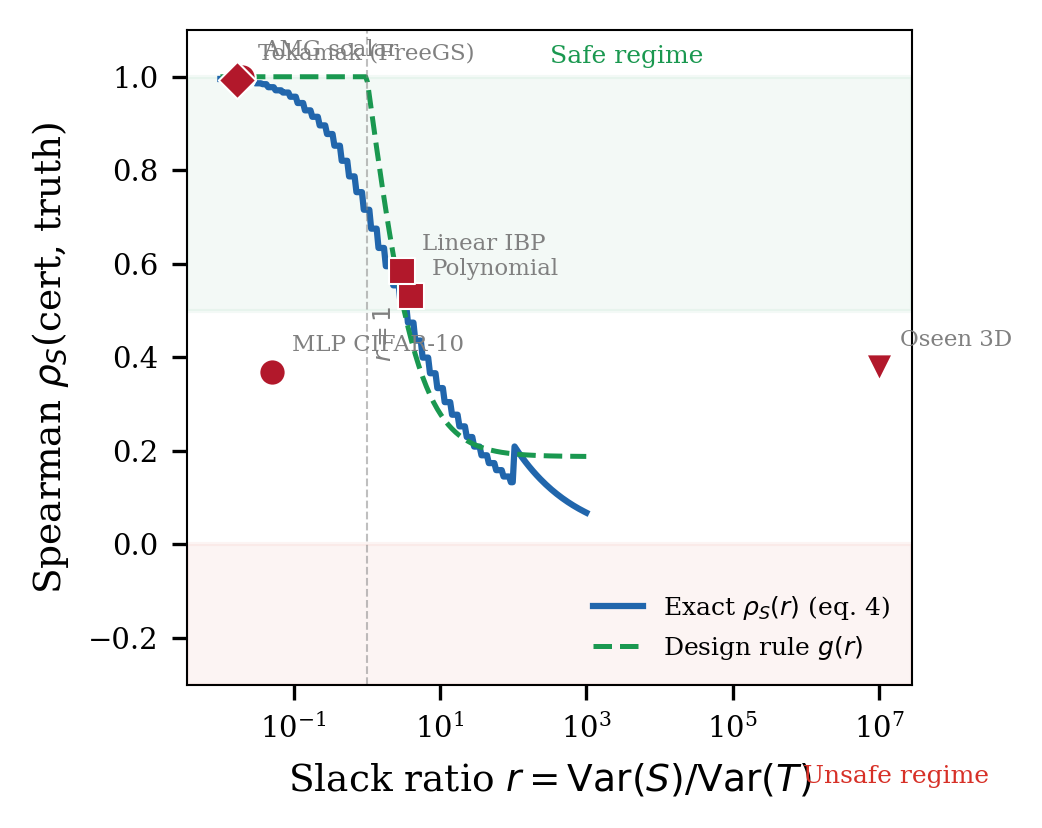
The calibrated curve \\(g(r)\\) against empirical Spearman across simulated slack ratios. The transition at \\(r = 1\\) separates safe from unsafe.
Why this matters: the Goodhart mechanism
Optimising against a certificate is a Goodhart game: the bound can be inflated without improving the truth. In the CIFAR-10 sweep, pushing the IBP regularisation weight from 0 to 20 raises certified accuracy from 0.11 to a plateau near 0.17–0.23 while true robust accuracy declines from 0.15 to 0.09. The bound never becomes invalid — it just stops ranking models the way the truth does. The same certificate is a faithful surrogate over one-parameter families and an unfaithful one over wider families; what flips it is the dimension of the family you descend over. The diagnostic makes this measurable before you commit to an optimisation run.
The design rule. Sample \\(N \\ge 30(1-\\rho_{ST})^{-1}\\) designs; evaluate \\(C\\) and \\(T\\); measure \\(\\rho_S = \\mathrm{Spearman}(C, T)\\). If \\(\\rho_S > 0.9\\), descend. If \\(0.5 < \\rho_S < 0.9\\), restrict to \\(\\le 10\\) candidates. If \\(\\rho_S < 0.5\\), the certificate is uninformative — use a different method.
The diagnostic, installable
pip install rank-fidelity

from rank_fidelity import Diagnostic

result = Diagnostic(certificate, truth).run(designs)
print(result.summary())
# n=52  rho_S=0.368 (p=0.0073)  r=4.97  rho_ST=-0.03
# regime: unsafe -> certificate is uninformative; use a different method
The package implements both theorems, bootstrap confidence intervals, permutation tests, and the sample-size rule. Full example in the repository.
Reproduce
git clone https://github.com/sehajr-singhs/rank-fidelity-paradox
cd rank-fidelity-paradox
pip install .
python -c "from rank_fidelity import Diagnostic; print('ok')"

# The verified CIFAR-10 experiment (52 MLPs) ran on Kaggle:
#   sehajrsingh/rank-fidelity-cpu-v10
# Per-model results: results/cifar10_verified_results.json
Every number in the paper traces to a committed JSON. The Kaggle kernel, notebook source, and figure scripts ship with the repo.