Why this matters for the field
The promise of structure-constrained latent predictors is that a physicist-recognizable operator (\( \dot z = J\nabla H - R\nabla S \)) yields a stable, dissipative, dynamically faithful world model. The atlas shows the promise fails at the level of the optimization: each constraint class certifies a functional level — spectral sums, windowed tangent maps, pushforward measures — and none of these levels controls the others.
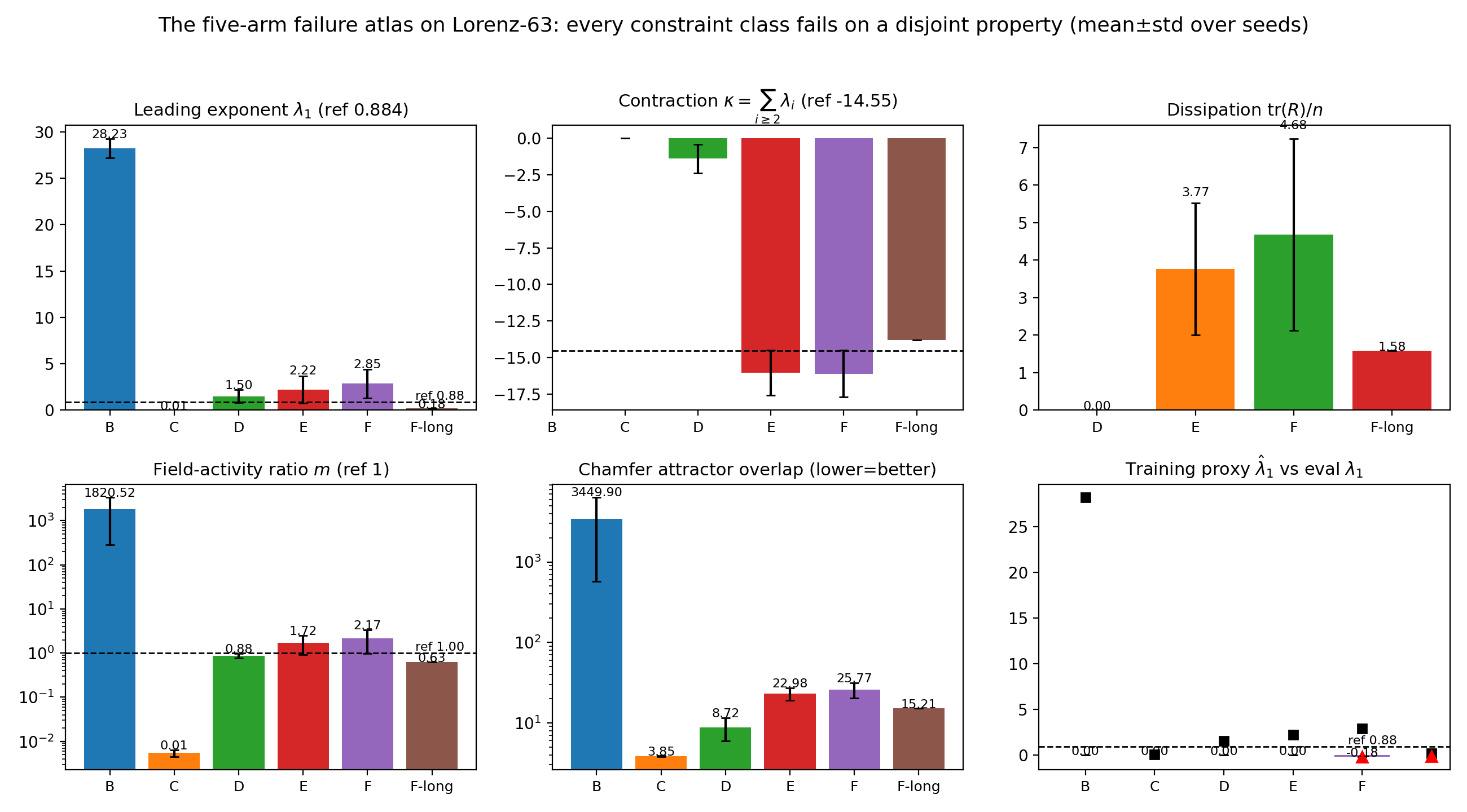
The divergence gate pins the spectral sum to within 1–3% on both systems, while the leading exponent runs 2.5–3.2× high on Lorenz-63 and ≈0 on the hyperchaotic flow — always off the reference, in a direction set by the system, not the constraint.
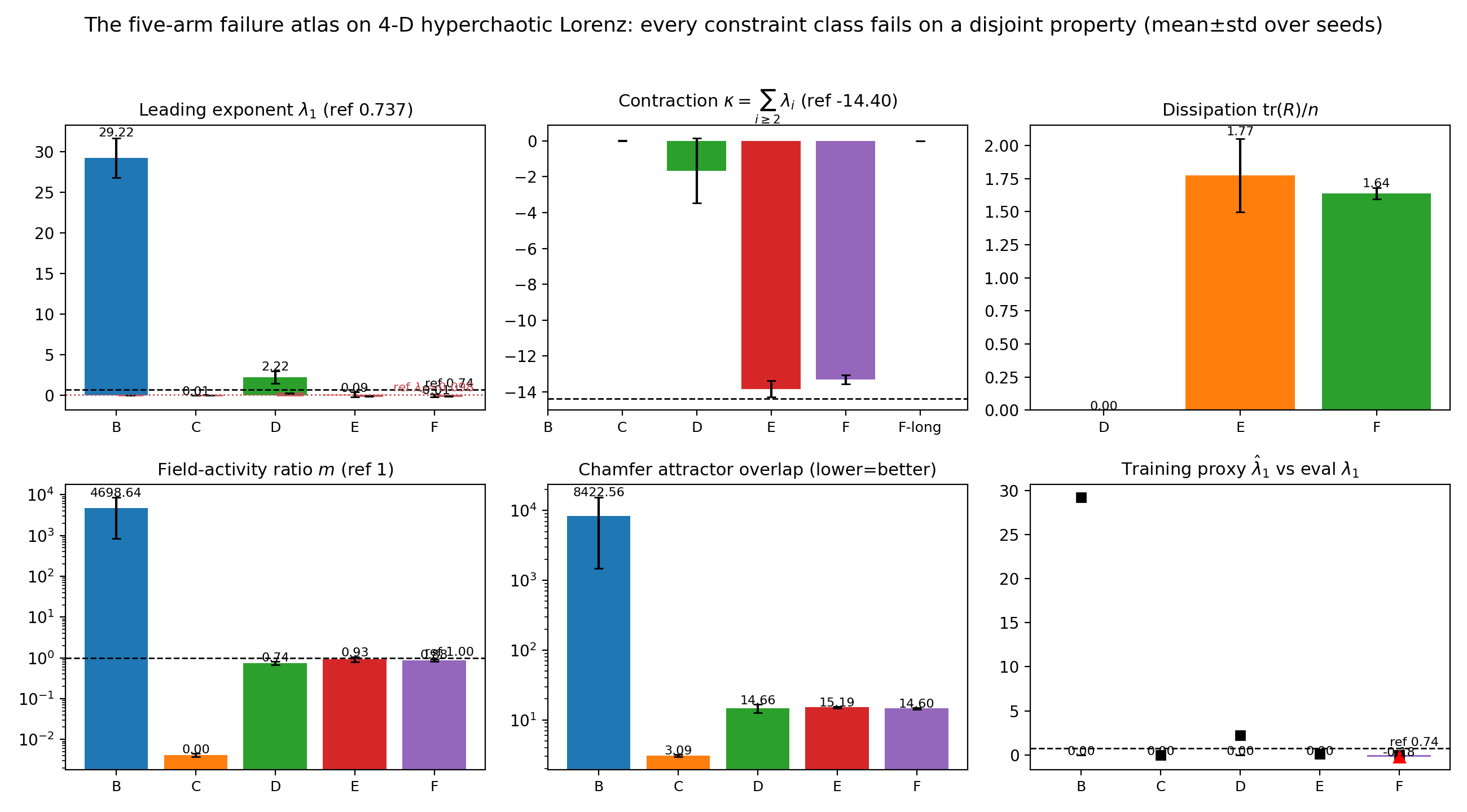
The reference second exponent is +0.098; the QR readout of every constrained arm is negative or zero (−0.08 for E and F). A λ₁-only spectral objective cannot even name the second unstable direction, let alone preserve it.
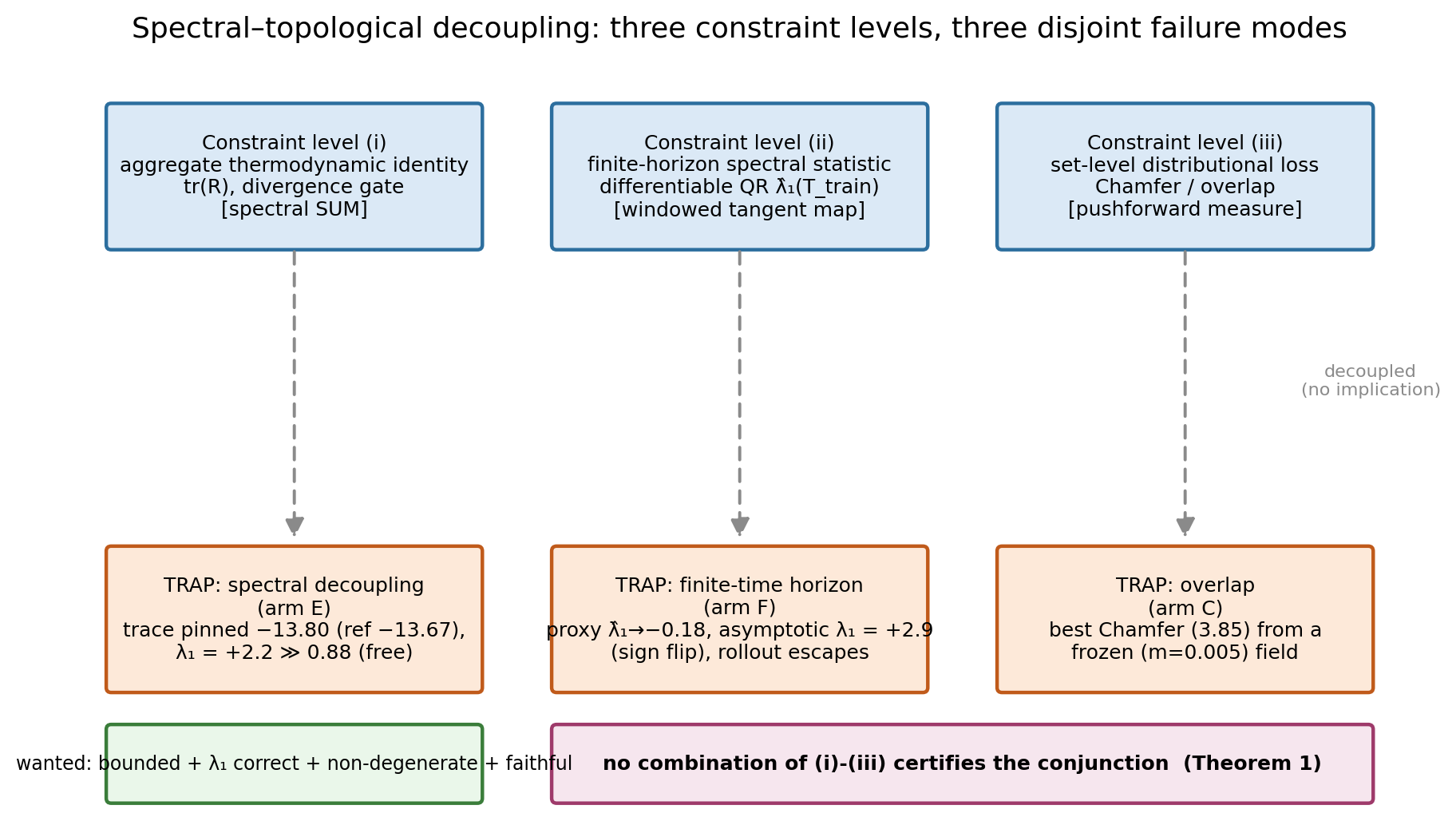
The overlap trap (a constant map posts the best Chamfer), the dead saddle (tr(R)/n ≡ 0.0000 with R = LLᵀ zero-init), and the finite-time-horizon trap (training proxy −0.18, asymptotic exponent +2.85 — a sign flip in every seed).
The five-arm failure atlas — Lorenz-63
Reference: λ₁ = +0.884, κ = −14.55, div f = −13.667. Mean ± std over three seeds.
| Arm | max‖z‖ | λ₁ | κ = Σλᵢ≥₂ | tr(R)/n | m | Chamfer |
|---|---|---|---|---|---|---|
| B · none (MLP) | 1.8×10⁶ (3/3 escaped) | +28.2 ± 1.3 | — | — | 1821 ± 1881 | 3.4×10³ |
| C · rigid Hamiltonian | 10.1 ± 0.3 | +0.011 ± 0.002 | +0.01 | — | 0.005 | 3.85 ± 0.05 |
| D · metriplectic, LLᵀ zero-init | 35.5 ± 24.5 | +1.50 ± 0.86 | −1.4 ± 1.2 | 0.0000 | 0.88 | 8.7 ± 3.3 |
| E · div-free J + gate | 175 ± 135 (2/3) | +2.22 ± 1.80 | −16.0 ± 1.9 | 3.77 ± 2.15 | 1.72 | 23.0 ± 4.8 |
| F · E + 6-step QR | 288 ± 288 (3/3) | +2.85 ± 1.89 | −16.1 ± 2.0 | 4.68 ± 3.13 | 2.17 | 25.8 ± 6.6 |
| F-long · E + 60-step QR | 54.2 | +0.18 | −13.8 | 1.58 | 0.63 | 15.2 |
| reference | — | +0.884 | −14.55 | — | 1 | 0 |
The same atlas — 4-D hyperchaotic Lorenz
Reference: λ₁ = +0.737, λ₂ = +0.098, κ = −14.40. Divergence −13.667, identical to Lorenz-63. Two positive exponents.
| Arm | max‖z‖ | λ₁ | λ₂ | κ | tr(R)/n | m | Chamfer |
|---|---|---|---|---|---|---|---|
| B · none (MLP) | 3.9×10⁶ (3/3) | +29.2 ± 3.0 | — | — | — | 4699 ± 4718 | 8.4×10³ |
| C · rigid Hamiltonian | 9.9 ± 0.2 | +0.011 ± 0.006 | +0.00 | +0.01 | — | 0.004 | 3.09 ± 0.12 |
| D · metriplectic, LLᵀ zero-init | 57.4 ± 22.5 | +2.22 ± 0.93 | +0.27 | −1.7 ± 2.2 | 0.0000 | 0.74 | 14.7 ± 2.4 |
| E · div-free J + gate | 66.7 ± 15.9 | +0.09 ± 0.38 | −0.08 | −13.85 ± 0.56 | 1.77 ± 0.34 | 0.93 | 15.2 ± 0.5 |
| F · E + 6-step QR | 62.2 ± 9.0 | −0.01 ± 0.20 | −0.08 | −13.31 ± 0.31 | 1.64 ± 0.05 | 0.88 | 14.6 ± 0.4 |
| reference | — | +0.737 | +0.098 | −14.40 | — | 1 | 0 |
No evaluation window certifies stability
The 2000-step (20 Lyapunov-time) convergence check on all 24 saved checkpoints is unambiguous: only the frozen arm C is converged. Every alive arm's 200-step value understates its 2000-step value by an order of magnitude — Lorenz E/F climb to +8.8…+10.0 and escape at steps 213–300; hyperchaotic E/F read ≈0 at 200 steps then climb to +7.8…+10.1 and escape at 304–407; the dead-saddle arm D, whose 200-step value is the nearest to reference, reads +4.5…+19.7 at 2000 steps. The atlas's verdicts are conservative, not optimistic: any evaluation window shorter than the instability's onset time can certify a pathological field.
The theorem
Three elementary propositions and a no-go theorem: (i) a trace/divergence gate pins only the mean eigenvalue and leaves the Rayleigh quotient along the leading Oseledets direction free up to a factor \(d\) — over spectra with fixed sum, λ₁ is unbounded above; (ii) finite-time exponents are non-certifying — for every finite \(T\) there exist flows with \(\Lambda_T < 0 < \lambda_1\), so a differentiable QR signal is not a bound on the Oseledets spectrum; (iii) Chamfer-type distances are reordering-invariant, so a constant map attains near-optimal overlap with zero dynamical information. No combination of aggregate thermodynamic identities, finite-horizon spectral statistics, and set-level distributional losses certifies {bounded, correct λ₁, non-degenerate, dynamically faithful} — realized simultaneously by the five-arm atlas on two systems, including the most constrained arm on both.
Reproducibility: deterministic per-step seeding (bit-reproducible from (seed, schedule)); independent retrainings reproduce the atlas within seed spread; the convergence check reruns the shadow exponent on the saved weights. Full protocol and code in the repository.