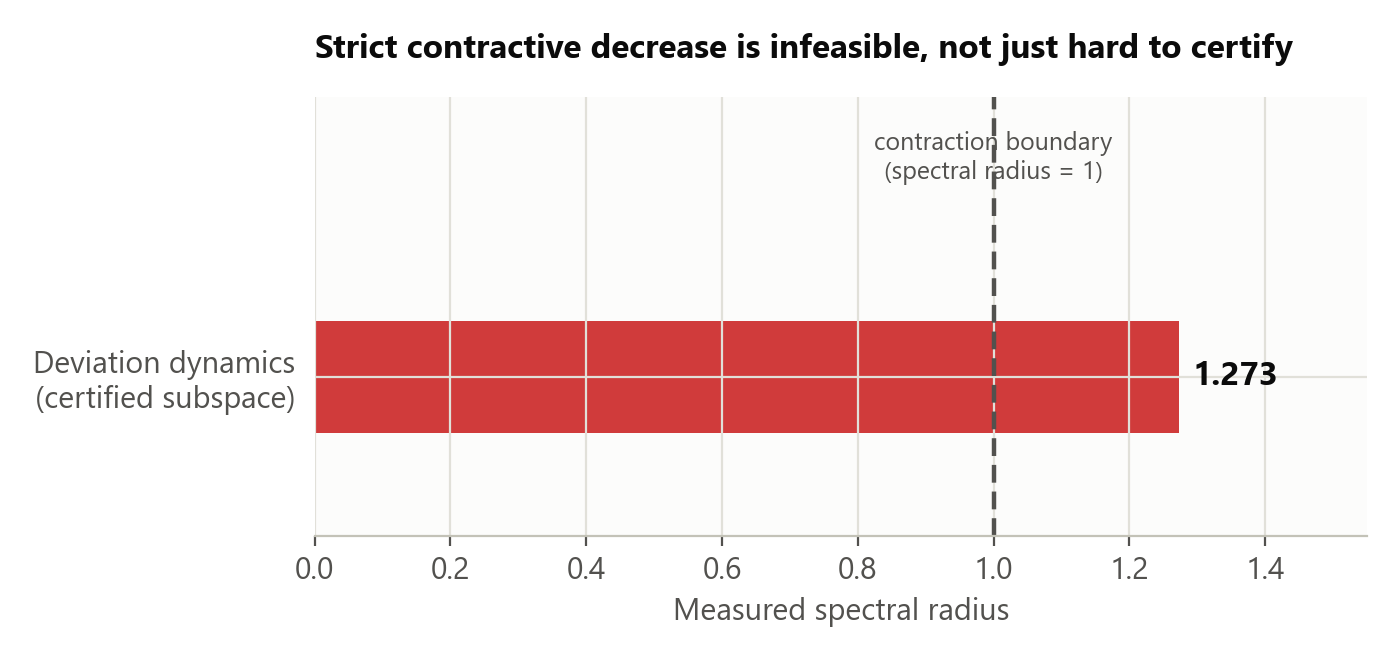
A strict Lyapunov decrease certificate is infeasible for this model — measured spectral radius 1.273 against a threshold of 1 — so the obligation is restated as bounded finite-horizon growth: proved by sound branch-and-bound, never sampled. This page reports what that restatement buys, where it stops scaling, and one comparison this project's own compute environment could not finish.
Independent research · formal verification of a toy transformer · 2026
This paper reports three narrow, measured results on small transformers and states plainly what they
do and do not support. All three are scoped to two toy systems: a 2-layer, d_model=32,
26,144-parameter transformer trained on a synthetic feature-routing task, and a family
of up to 4-layer, d_model up to 256, at most 300,000-parameter character-language models
trained on TinyShakespeare. Neither has been shown to hold at production scale. On the routing-task
model, a strict contraction certificate for the residual-stream deviation dynamics is infeasible: the
measured spectral radius on the certified subspace is 1.273, above the threshold of 1
required for any positive-definite Lyapunov function to exist. Depth compounds the same difficulty on
the character-language models in a way that does not follow a smooth power law. Putting a sound
interval-bound term into the training loss collapses the run-to-run spread of the certified gap from
1705× to 1.08× at the one grid cell where it converges — 18 of 18 other
cells diverged, and a further 9 of 9 runs diverged under three deliberately gentler schedules run
specifically to test whether that limit would move. No claim in this paper has been demonstrated to
transfer to a production model, and none of the results is offered as a general law of transformer
architectures.
What this is. A sound, from-scratch hybrid-zonotope branch-and-bound certifier for a
26k-parameter, 2-layer transformer, plus a scaling study on up to 300k-parameter character-language
models. Every number is read from a results/*.json file by a generator script; nothing in
either paper is hand-typed.
What this is not. A production-scale result, a general theorem about transformer architectures, or a claim that any of the four safety-relevant findings below transfer past the two toy systems they were measured on.
What's reported as failing, not hidden. An independent auto_LiRPA/CROWN baseline
attempted four times and never completed in this compute environment (documented, not fabricated — see
Results). A schedule search run specifically to make certified training converge past
d_model=32, which did not succeed (9 of 9 runs diverged). Both are written into the papers
as negative results, not omitted.
Nothing in this project is trusted on the say-so of the engine that produced it. Every discharged box is replayed with dense sampling and PGD by a second process. The primitives are checked against z3 over exact rationals — that check is what caught a real bug (a sound-but-loose readout inflating the bound by ~11.7 logits) that a soundness-only regression test missed. Two independent from-scratch reference engines and a CROWN-style engine were built to cross-check the end-to-end bound; where they lose to the native prover, the loss is localized and explained rather than shrugged at. And the training signal used to build the one certified-by-construction model was put under a gradient-based adversarial search looking specifically for where it lies.
That last check is the sharpest example, so here it is up front rather than at the bottom of the page. The search found real, repeatable slack in the differentiable training signal — a 16.9× relaxation-gap increase on adversarial contexts, reproduced in 5 of 5 restarts. Checked black-box against the actual certifying prover, which was never part of the search, the same adversarial context moved the sound bound by only 1.05×. The gap the attack found in the proxy did not transfer to the thing actually being certified. That is not proof the certifier is unbreakable — it is one context pair, stated as one context pair — but it is the difference between a claim that was checked and a claim that was assumed. Full protocol, scope, and the honest caveats are in Adversarial stress test below.
Treat the residual stream as a discrete-time nonlinear dynamical system with the layer index as time, work in deviation coordinates \(e_l = x_l - x^*_l\) around a nominal trajectory, and formalize alignment safety as an invariant sublevel set of a positive-definite \(V\) whose behaviour along layers is proved rather than sampled:
Threat model. Activation steering along 4 SAE decoder directions at the final token, \(e = \sum_j \alpha_j U_j\), \(|\alpha_j| \le \rho\). Safety property. The unsafe-logit margin \(s(x) = \max_{v\in\text{unsafe}} \text{logit}_v - \max_{v\in\text{safe}} \text{logit}_v\) stays negative. Bridging this to any real notion of harmful behaviour is a semantic assumption, stated as one, not a proved step.
Two of the original design assumptions did not, and both are load-bearing rather than embarrassing — the paper's actual contribution is what replaces them.
1. Strict decrease is infeasible, not just hard. A positive-definite \(V\) with \(V(e') \le \gamma V(e)\), \(\gamma < 1\), exists iff the deviation dynamics has spectral radius below 1 — standard Lyapunov theory, not a new claim. Measured on the certified subspace it is 1.273. No relaxation tightening or training schedule can produce that certificate, so the obligation is restated as bounded finite-horizon growth: certify the smallest provable \(\gamma_l\) per layer and compose. Still by construction, still sampling-free.
2. Small-gain composition cannot certify a residual stream. The exact identity path forces \(\gamma_{\text{layer}} \ge 1\) unconditionally; the measured cascade product is 5562.9. Contraction would have to come from sign-aware cancellation, which a norm gain discards by construction. The compositional payoff here is O(L) independent discharge, not gain multiplication.
By sound hybrid-zonotope branch-and-bound at 2048 boxes, the certified radius reaches \(\rho = 0.04\). Independent falsification across 3209 discharged boxes (2048 samples plus 30-step PGD each) finds no violation of any box's own bound and exact coverage of the threat set. z3 over exact rationals confirms the margin readout 8/8 sound, 7/8 tight — and it is the tightness query, not a soundness-only test, that caught a real bug: a sound-but-loose readout inflating the bound by ~11.7 logits.
discharged boxes replayed with sampling + PGD; exact coverage of the threat set, zero violations
margin readout sound / tight; caught an ~11.7-logit readout bug a soundness-only test would have missed
amplification through two blocks for any decorrelating abstraction — motivates the structure-preserving prover
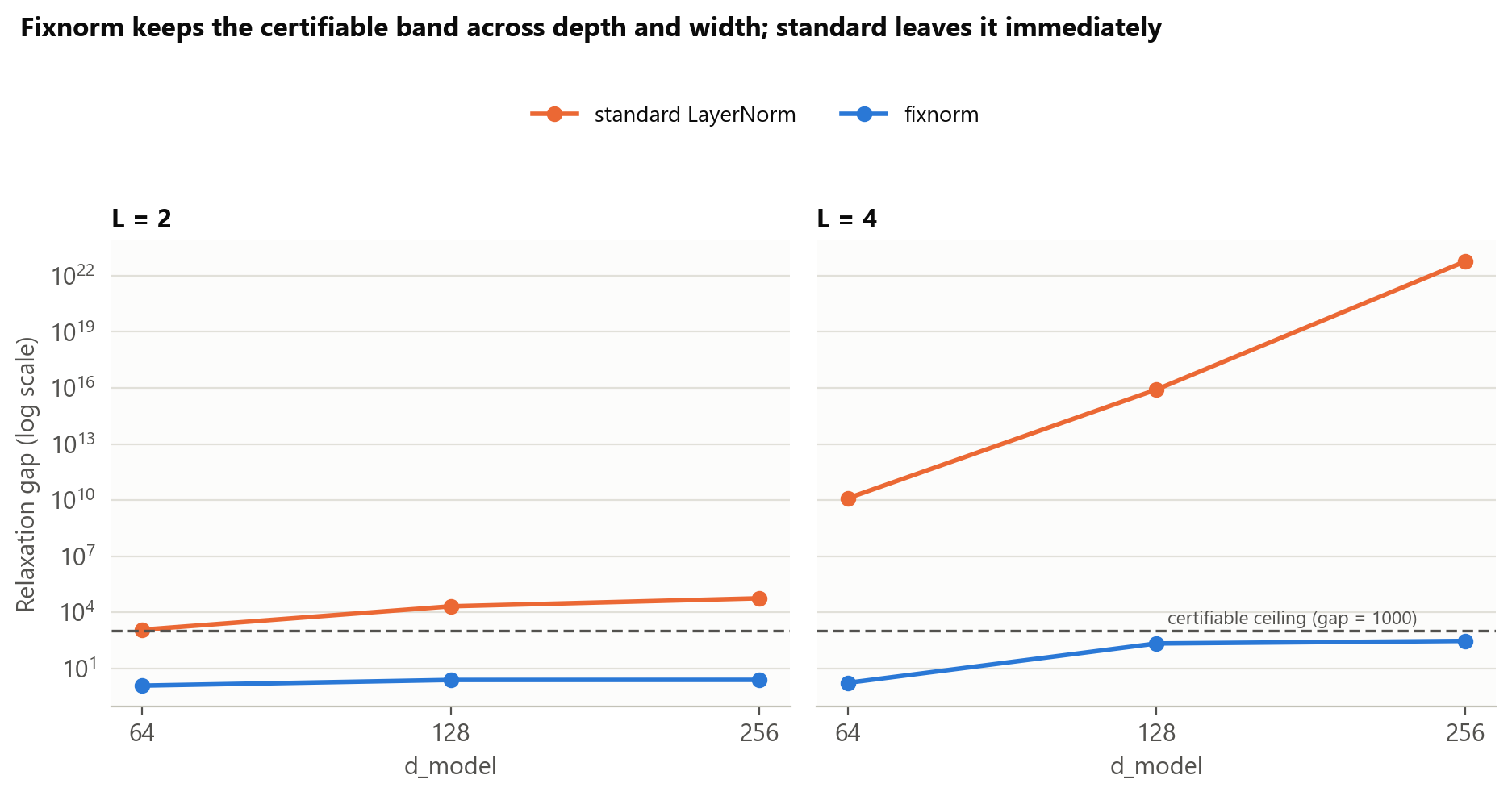
fitted width-scaling exponent on random init — the wall is delayed, not removed, and still super-linear
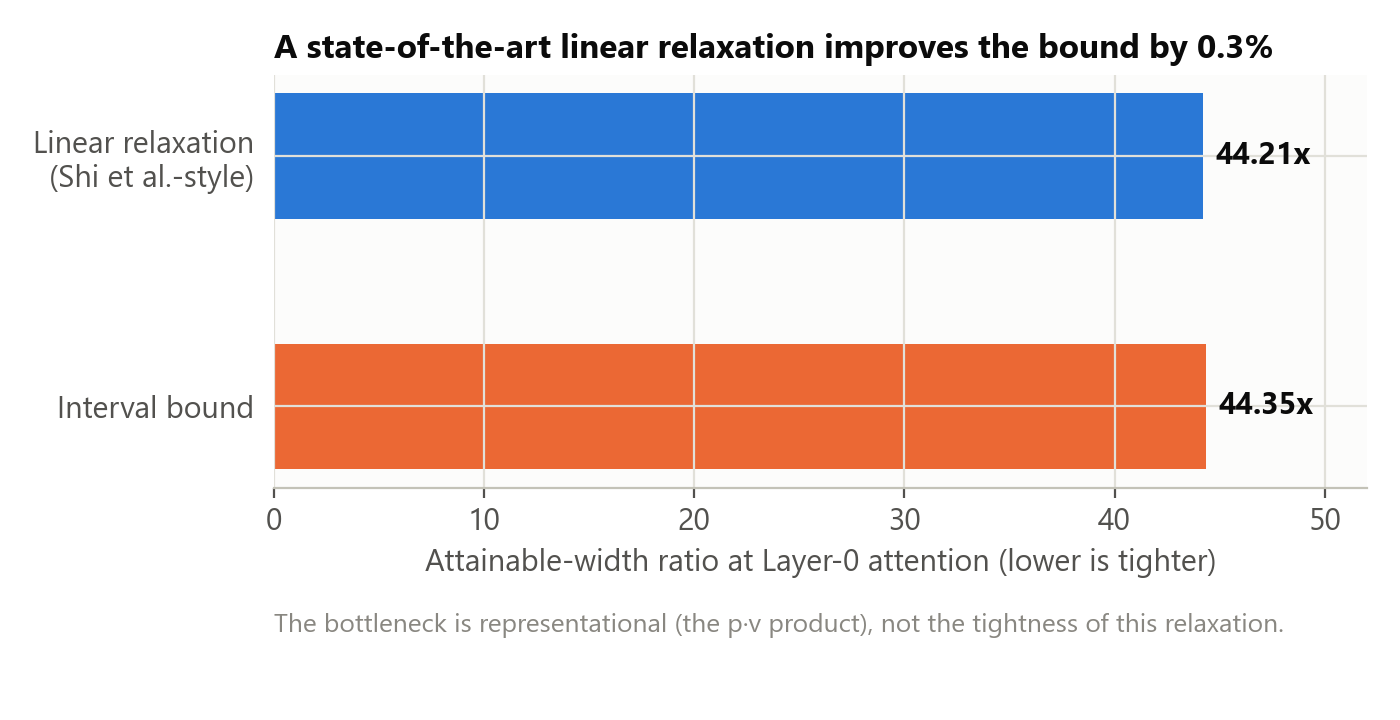
Two from-scratch reference engines (interval-bound, mean-value-form) are vacuous on this model — any decorrelating abstraction amplifies 4.7×10⁸ through two blocks, so the final LayerNorm's structural clamp is all that keeps the bound finite. A CROWN-style engine built specifically to keep the 4-dimensional steering structure exact still loses, and the loss is localized: it tracks the prover to 1.61× at layer-0 LayerNorm and diverges to 39.5× (prover: 3.86×) at layer-0 attention, because softmax uncertainty enters as interval coefficients.
The auto_LiRPA baseline — reported as an attempt, not a result. An independent
comparison against auto_LiRPA's CROWN implementation, on this exact trained model and threat model, was
attempted four separate times. auto_LiRPA itself is verified working in this environment — a standalone
two-layer MLP returns a CROWN bound in under a second, and this project's own tail model wrapped in
BoundedModule returns a real bound in isolation. The full comparison (retrain, then wrap)
never completed across four attempts, at system loads ranging from 47% to 100% to a normal 45% — a
spread that rules out simple resource contention as the sole explanation, and the actual cause was not
further diagnosed. Both halves of the comparison are independently verified working; the code that runs
it is audit/c31_autolirpa_baseline.py; this project's local compute environment did not
produce a completed run. That is the honest status, reported in Section III-C of the IEEE paper rather
than left out.
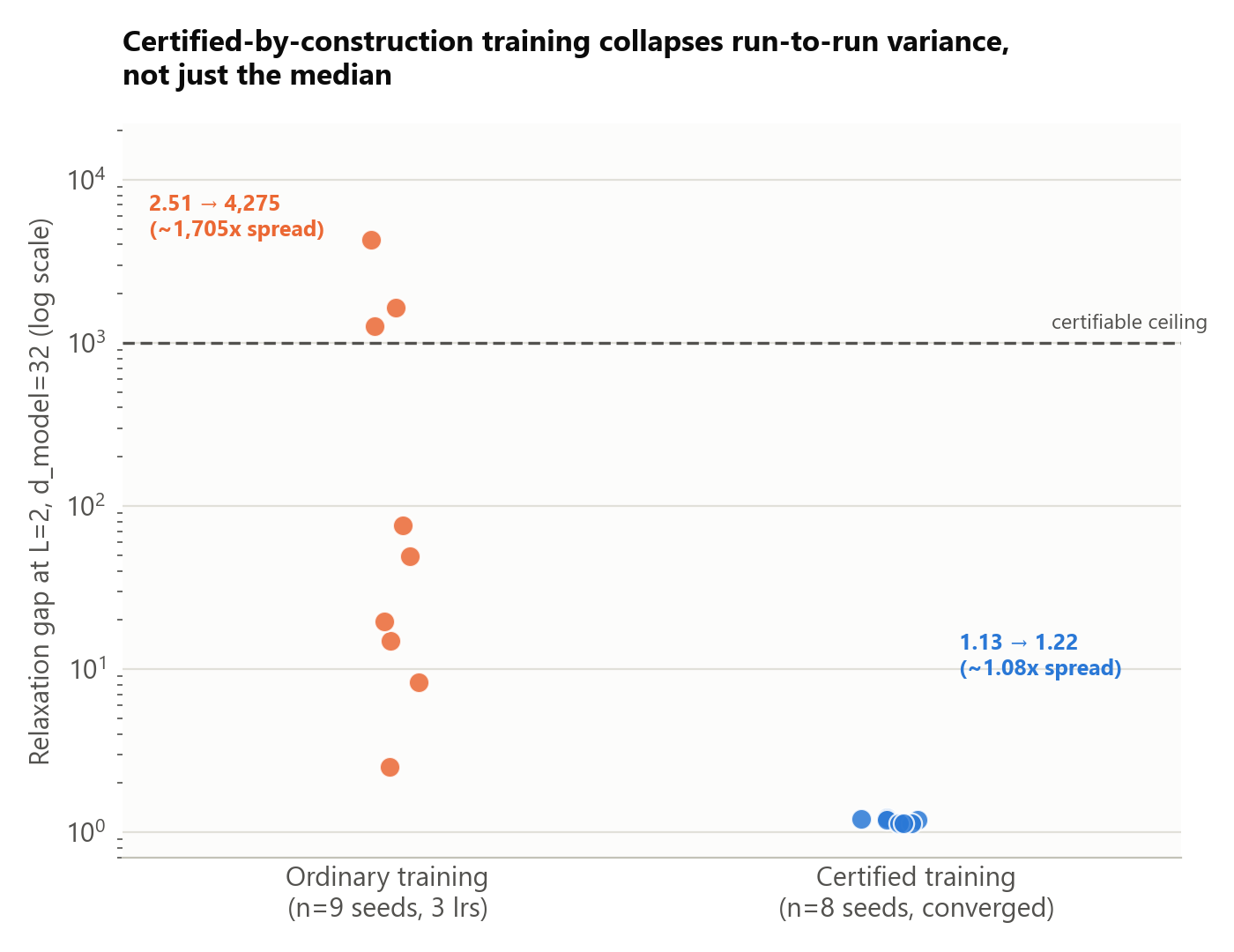
Putting a sound interval-bound term into the training loss collapses the run-to-run spread of the certified gap from 1705× to 1.08× at \(L=2\), \(d_{\text{model}}=32\), fixnorm, with zero unstable ReLUs on every converged run, at a perplexity cost of 13.3–28.0%. This is reported for exactly the one cell where it holds: 18 of 18 other (depth, width, arm) combinations diverged at every learning rate under the schedule used throughout.
Three deliberately gentler epsilon-ramp schedules were then run specifically to test whether that limit was an artifact of one schedule choice — a smaller target radius, a much slower ramp, and both combined, three seeds each at \(L=2\), \(d_{\text{model}}=64\). All 9 runs diverged. This rules out the two most obvious fixes without ruling out every possible schedule in a space too large to search exhaustively here. The question was tested directly rather than left open, and the answer at this compute budget is still divergence.
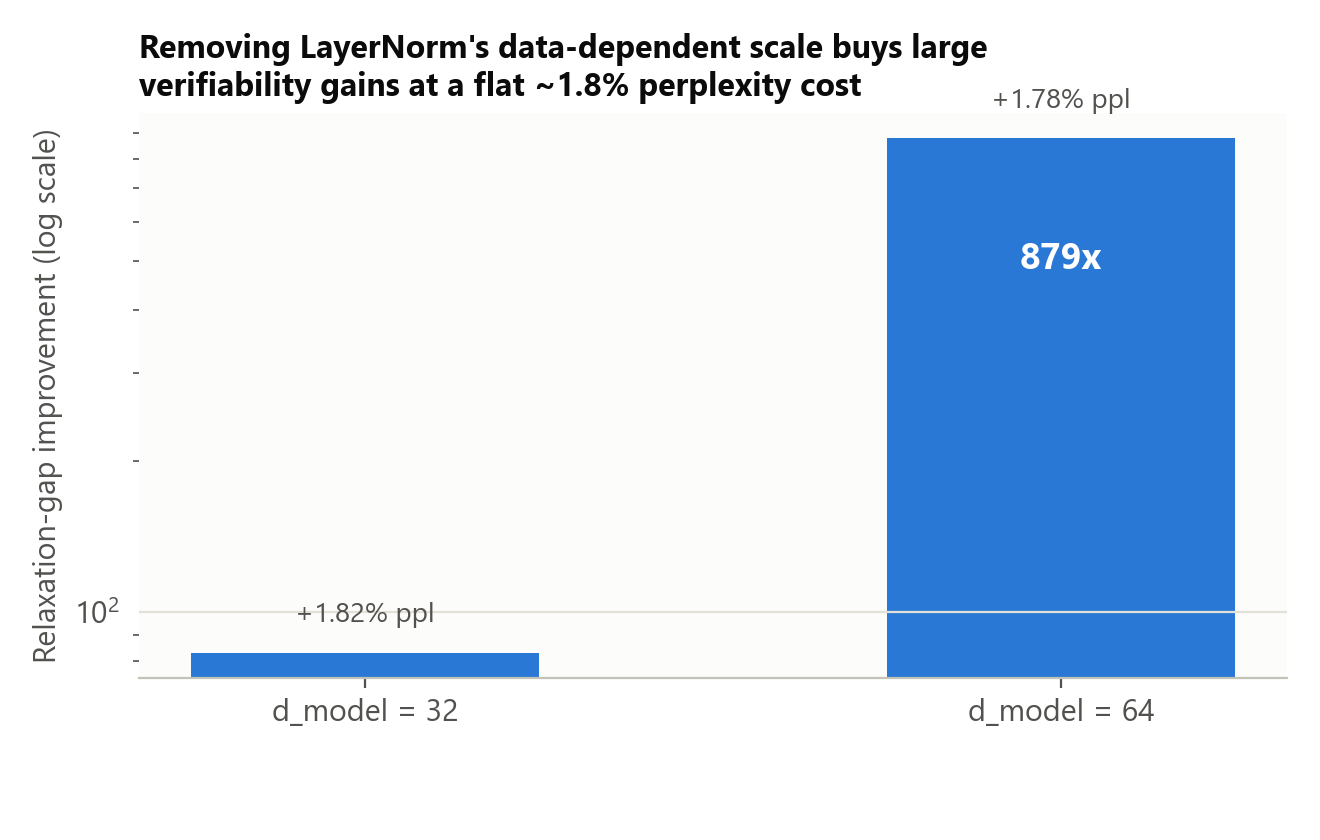
d_model 32 to 64 for a flat ~1.8% perplexity cost.A gradient-based search against the differentiable training-signal engine (interval arithmetic, not the certifying prover) finds real, repeatable out-of-distribution sensitivity: a 16.9× relaxation-gap increase on repeated-token contexts, reproduced in 5 of 5 restarts. Checked black-box against the actual certifying zonotope prover — never part of the gradient search — the same adversarial context shifts the sound bound by only 1.05×, both points remaining far inside the certified band with exact containment (worst violation 8.9e-15, float noise). One context pair, not a swept claim in either direction — but the direction is the interesting one: the correlation-preserving engine did not inherit the differentiable engine's blind spot on this search.
The Anaconda build this was developed against ships a duplicate libiomp5md.dll;
src/__init__.py pins KMP_DUPLICATE_LIB_OK before torch is imported, so import
src first. Every number in the papers is regenerated from results/*.json by
these scripts, never hand-typed.
pip install -r requirements.txt python tests/smoke.py # fast sanity + soundness python tests/test_alignment.py # the invariant that bit us python stages/a0_bootstrap.py # full pipeline (~15 min, CPU) python src/report.py # regenerate ARCHITECTURE.md python audit/report_manuscript.py # regenerate MANUSCRIPT.md from results/ python audit/verify_bundle.py # gate: every artifact present, synced, hashed
See the repository
for the full README, soundness discipline, and the 30-script audit trail. LaTeX sources for both papers
(nmi_paper.tex, ieee_paper.tex) are included and regenerate with
pdflatex against the real Springer Nature and IEEE templates.
@article{singh2026certified,
title = {Certified Safety Margins for a Transformer Residual Stream},
author = {Singh, Sehaj},
year = {2026},
note = {Sound hybrid-zonotope branch-and-bound certification of a toy
transformer's residual stream; scaling and certified-training
study on character-language models},
url = {https://github.com/sehajr-singhs/transformer-residual-stream-verification}
}