A transformer that reasons about physics should not first translate physics into words. This paper develops a physics transformer whose substrate is the manifold of physical spacetime — mapping discrete telemetry, mathematical equations, and continuous fields into one unified tensor representation. The resulting architecture, the UGCT, is organized in four tiers: foundational physics (INR tokenizers, SE(3)-equivariant attention, Fourier neural operators), topological consistency (sheaf-theoretic Clifford latent space, FVM flux conservation, Nash bargaining), mathematical engineering (homotopic grade-fading, symplectic spectral scrubbing, non-commutative autodiff), and real-world deployment (wavelet sparsification, TDA de-noising, Bayesian uncertainty). The paper's core contribution is an adversarial design analysis: every component is tested for its failure modes, the failures patched, and the patches tested in turn. Each fix introduces a new failure — frame averaging snaps, domain decomposition leaks, gradient surgery stalls in null spaces, latent bottlenecks act as low-pass filters, and purely topological representations collapse against dissipative physics. The terminal resolution is a self-defending stack that enforces the rules of the universe inside the network rather than memorizing them from data.
The one idea
Token-based models represent a voltage trace, a stress tensor, and a differential equation as sequences of discrete symbols, then try to recover the underlying laws from symbol statistics. The UGCT instead processes the continuous field itself, through four deep structural layers:
Multi-modal physical tokenizer: INRs and coordinate networks project every datum as a continuous function bounded by (x, y, z, t); equations become structural weight matrices via graph-to-tensor encoders.
SE(3)-equivariant attention preserves symmetry and conservation in the weights; FVM flux locks and Nash bargaining keep coupled physics honest.
Grade-fading, symplectic projections onto ker d, and Clifford autodiff kernels make the non-commutative, dissipative latent space trainable at scale.
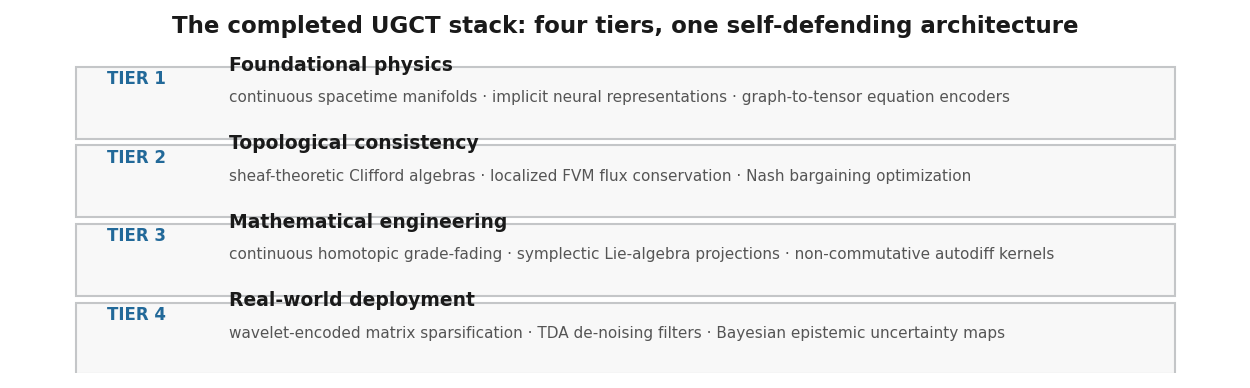
Wavelet-encoded sparsification, topological de-noising, and Bayesian epistemic uncertainty maps close the loop for regulators and insurers.
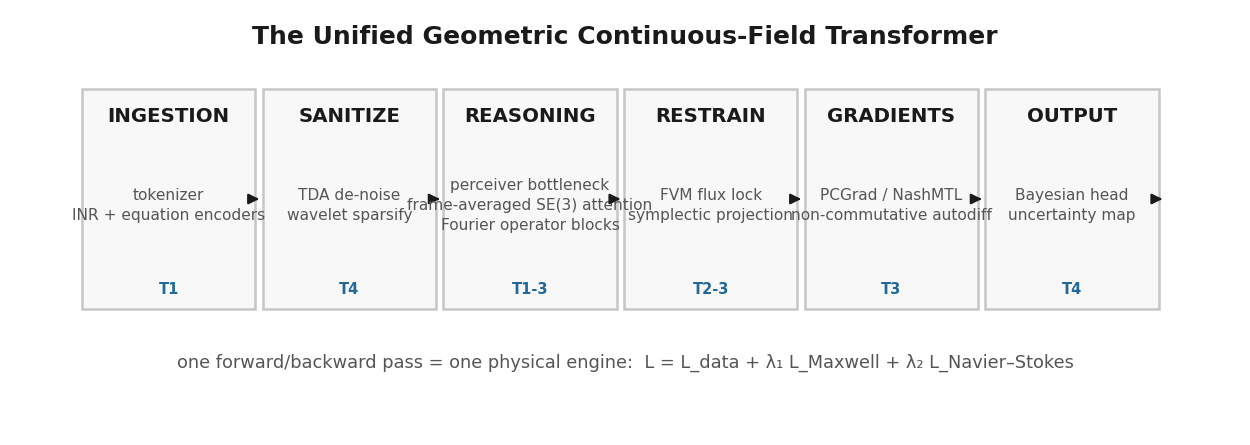
One forward/backward pass functions as a single physical engine: ingest raw telemetry, CAD meshes, and equations into an asynchronous latent bus; sanitize with TDA and wavelet sparsification; reason with Clifford operators and equivariant attention; restrain with symplectic hardlocks and FVM boundaries; update with non-commutative autodiff; and output a hyper-optimized design complete with a Bayesian uncertainty map.
Why the naive architecture fails
The naive UGCT is mathematically appealing and computationally hopeless. Four bottlenecks, each formalized as a proposition in the paper:
- The curvature-memory explosion of SE(3) equivariance. Steerable attention costs O(N²K²): memory grows quadratically with context length and geometric complexity. A fully equivariant transformer over a jet engine assembly crashes GPU clusters.
- The non-local cost of Fourier neural operators. A global FFT needs the whole field simultaneously — destroying GPU caching — and assumes a structured grid, forcing expensive transforms on complex geometries.
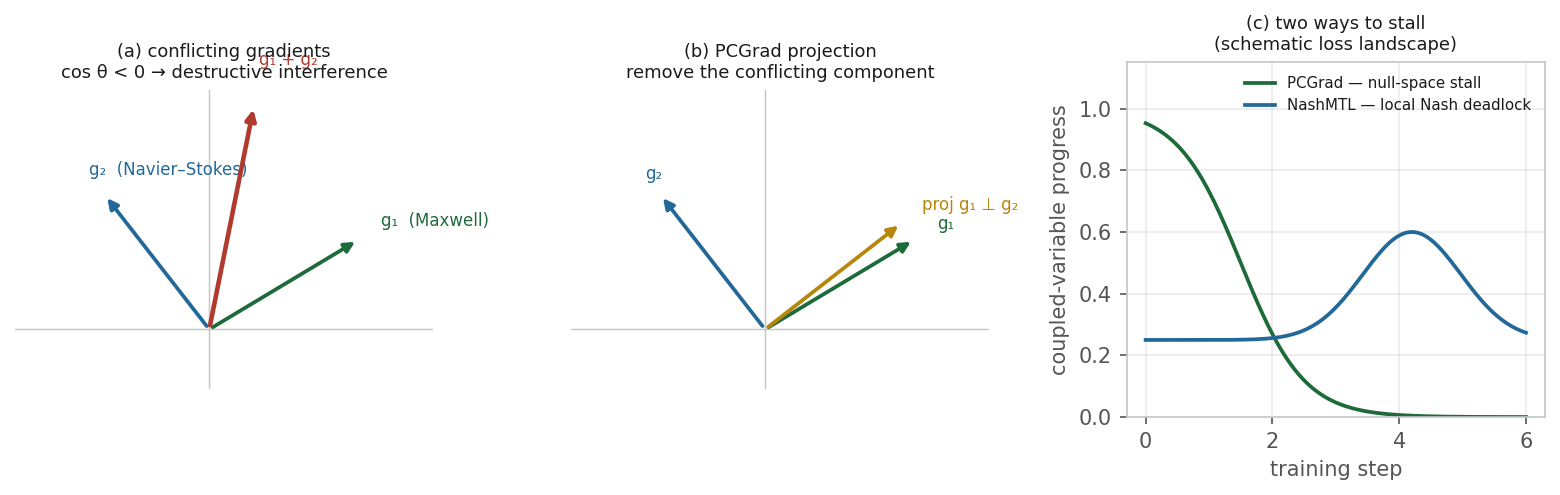
- Multi-physics gradient conflict. When ∇LMaxwell · ∇LNavier–Stokes < 0, the summed update actively destroys one of the residuals; fluid-dynamics gradients drown out electromagnetic adjustments.
- The data-integration paradox. Forcing continuous INRs to align with structured equation encodings in real time stalls preprocessing before the forward pass begins.
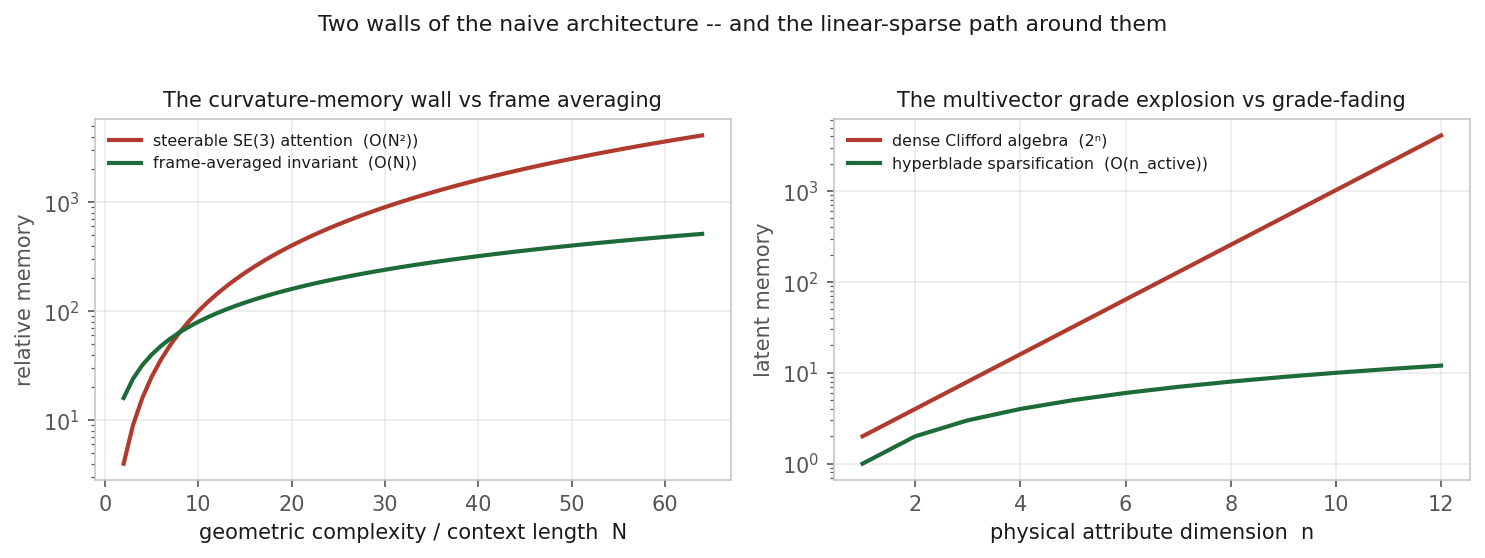
Steerable SE(3) attention scales quadratically; frame averaging linearizes it. Dense Clifford algebra is 2ⁿ; hyperblade grade-fading is linear in the active grades.
The fixes and their flaws
The analysis is a dialectic: each bottleneck admits an engineering fix, and each fix introduces a new failure mode.
| bottleneck | first-order fix | residual flaw | consequence |
|---|---|---|---|
| SE(3) curvature-memory | frame averaging / vector neurons | frame discontinuity: canonical frames snap at symmetry crossings | discontinuous gradients, erratic loss spikes |
| FNO non-locality | GINOT + domain decomposition | boundary conservation leaks: flux mismatch at every artificial interface | energy spuriously created/destroyed; numerical blowups |
| gradient conflict | PCGrad + NTK balancing | null-space traps on coupled variables | the optimizer makes peace by doing nothing |
| data paradox | Perceiver latent bottleneck | low-pass information loss | shock fronts and micro-cracks erased |
And the second round of fixes collides with the architecture's own mathematics: continuous Haar integration blurs orientation (aliasing against the wavelet bypass) and adds Monte-Carlo variance on the 6-D manifold; FVM flux locks require a mesh, destroying INR mesh-independence; Nash bargaining deadlocks at local equilibria where one physics domain must temporarily suffer. The accumulation of contradictions forces the paradigm shift.
The topological paradigm shift
Stacking patches on a coordinate-based backbone puts the architecture at war with its own math. The resolution: step out of spatial-temporal coordinate grids entirely and operate natively in a sheaf-theoretic Clifford algebra latent space, mapping physics as topological invariants on fiber bundles that remain true under deformation, rotation, and scale change.
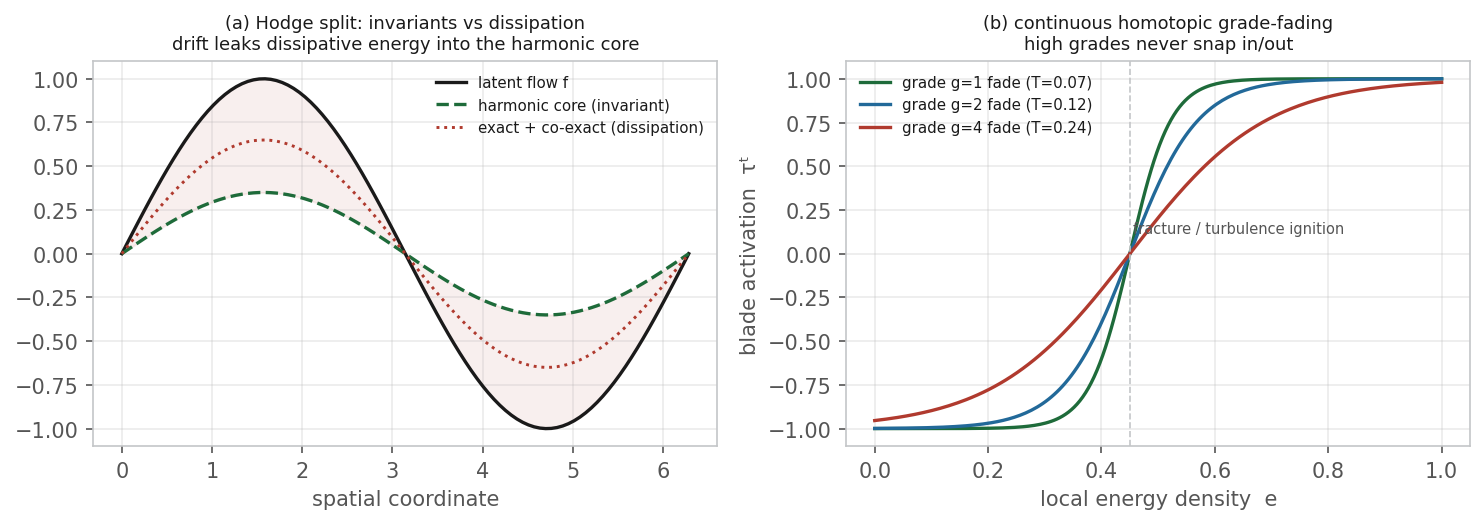
- Dissipative Hodge decomposition. The latent field splits into exact, co-exact, and harmonic components: topological invariants govern the harmonic core (the permanent structural baseline), while entropy-increasing thermodynamics decay through the non-harmonic flows.
- Hyperblade grade-fading. High-grade Clifford blades are never turned on or off — a continuous homotopy parameter τ ∈ [0, 1], scaled by localized energy density, fades them in as a fracture or turbulence front ignites.
- Hodge–Laplacian spectral backpropagation. Instead of enforcing vanishing cohomology (H¹ = 0) as a combinatorial check, minimize the spectrum of the Hodge–Laplacian directly, so standard local chain-rule backpropagation flows across the complex.
Hodge splitting keeps the invariant core while letting energy decay — and grade-fading ensures high grades never snap in or out.
The three sovereign interlocks
Three final constraints remain — hyperblade aliasing, Hodge spectral drift, and the non-commutative autodiff bottleneck. These are not bugs in the code; they are the toll physical reality extracts when its non-commutative, dissipative, multi-scale nature is forced into silicon. Each receives a structural interlock:
| final constraint | sovereign interlock | defense |
|---|---|---|
| hyperblade aliasing (grade-symmetry breaking) | continuous homotopic grade-fading (τ ∈ [0, 1]) | no latent shockwaves; linear-sparse memory |
| Hodge spectral drift | symplectic Lie-algebra projection (QR onto ker d) | invariant baseline hard-locked; dissipation cannot warp structure |
| non-commutative autodiff bottleneck | custom Clifford-autodiff Triton/CUDA kernels | orientation tracking parallelized; backward pass scales |
The deployment tier completes the stack: wavelet-encoded matrix sparsification drops dead uniform space from the Clifford computation; TDA de-noising filters sensor noise by its topological lifespan without dulling real micro-cracks; and Bayesian physics-informed ensembles ship every prediction with an epistemic uncertainty map constrained by the hardcoded conservation laws — the verifiability argument regulators require.
The epistemic bootstrap paradox
The architecture reasons with hardcoded physics to avoid brute-force data — but calibrating it still needs an initialization corpus. If that corpus comes from legacy simulators, the model learns the simulator's discretization bugs, and the architecture's rigor hyper-enforces them into dogma. The gray-box resolution: extreme domain randomization (mutate friction, viscosity, latency across millions of environments so the operator learns only the invariant physics that survive universal chaos), PID as a control anchor (a mathematically bounded error-correction loop handles micro-adjustments while the neural operator predicts the global field), and coverage (if the randomization bounds contain the real parameters, zero-shot transfer holds without a hardware-in-the-loop farm). The terminal limit — the unmodeled-physics wall — is why the uncertainty head must eventually be grounded in real hardware.
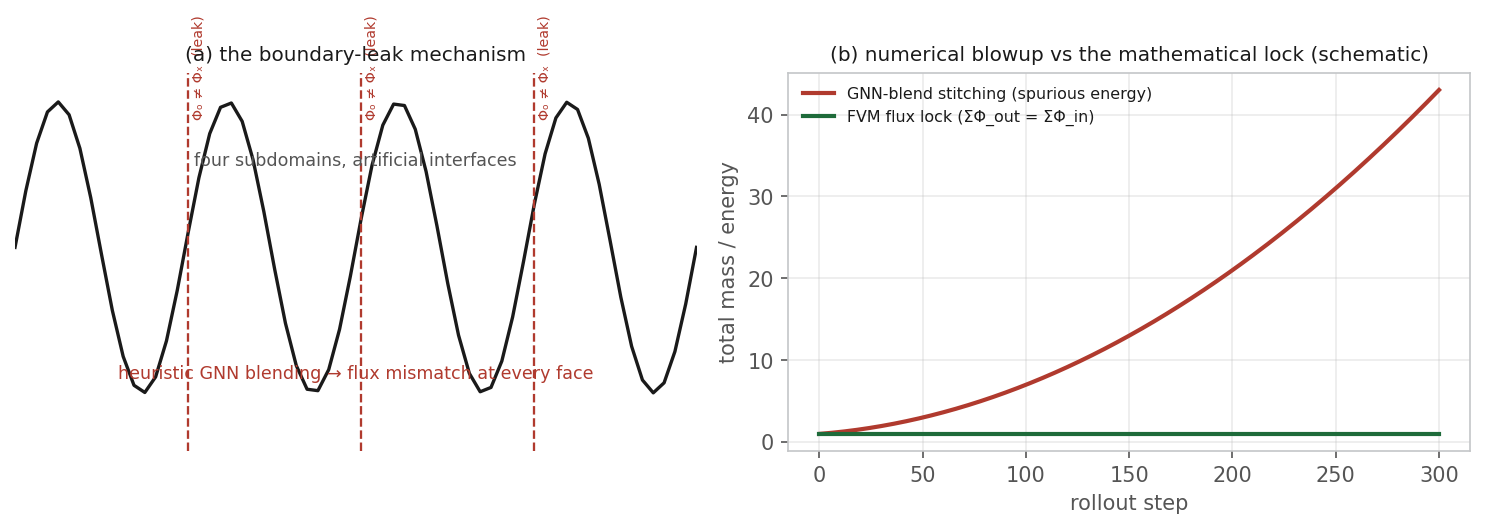
Heuristic GNN blending leaks at every artificial interface; the FVM flux lock (ΣΦ_out = ΣΦ_in) conserves to machine precision.
Play with the failure modes
Two interactive demos, straight from the paper's reference implementation. No model files, no server — the geometry and the gradients themselves.
Experimental validation
Seven controlled experiments: E1–E6 isolate one headline claim each (each reproduces the predicted failure mode and confirms the fix), and E7 assembles the operator backbone and the physics-constrained loss and trains the integrated system end-to-end on the canonical Navier–Stokes operator benchmark. Every figure is regenerated by a committed script; every number below is a committed JSON result (deterministic seeds), CPU-only in seconds to minutes (E7 under ten minutes per Reynolds number on a single GPU).
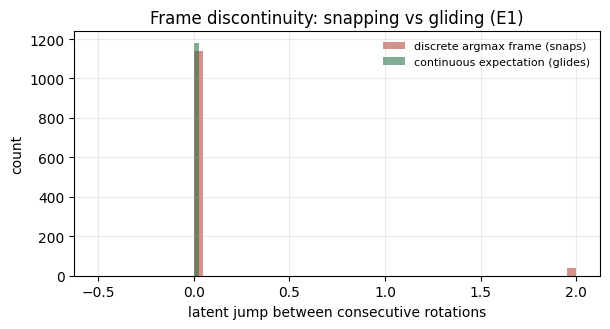
Discrete frame selection snaps (max latent jump 2.0, 3.4% of steps); the continuous Haar expectation glides (max jump 0.0). Prop. on frame snapping confirmed.
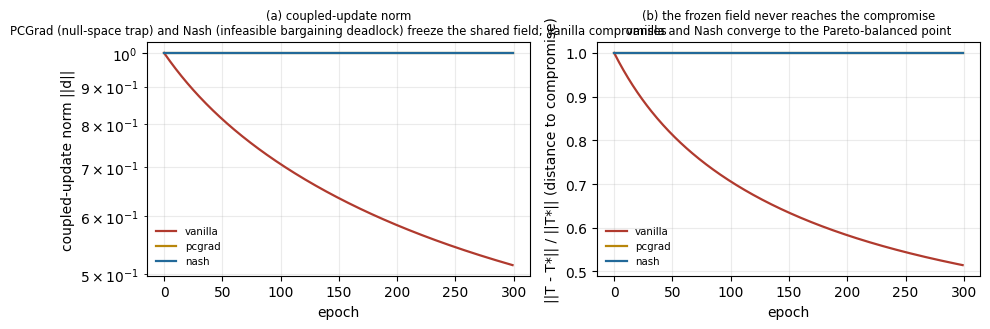
On a coupled field with exactly anti-parallel residuals, PCGrad and NashMTL freeze the shared update to 0.000 (null-space trap + bargaining deadlock); plain SGD alone reaches the compromise.
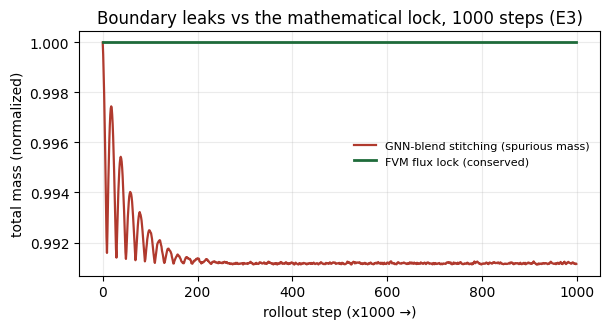
Over 1,000 advection steps the naive boundary stitcher injects a spurious source of 8.90 and destroys 0.88% of the mass; the FVM flux lock is exactly 0.0.
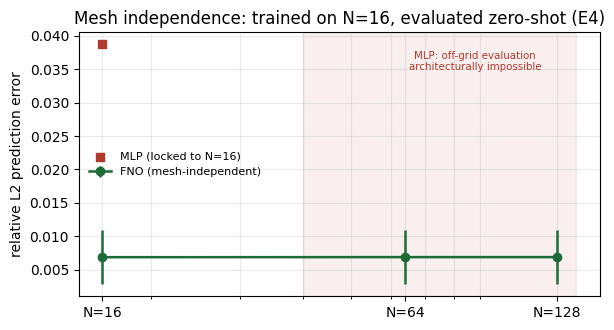
The Fourier operator trains at N=16 and evaluates zero-shot at N=16/64/128 with identical error (0.0069); the MLP baseline is architecturally locked to N=16.
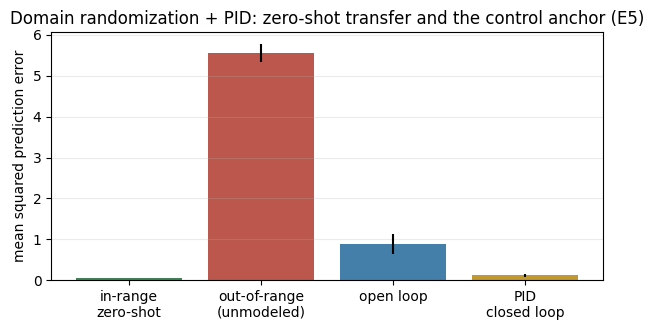
In-range coefficients transfer zero-shot (MSE 0.060); out-of-range hits the unmodeled-physics wall (5.55). The PID loop cuts open-loop error 0.875 → 0.115.
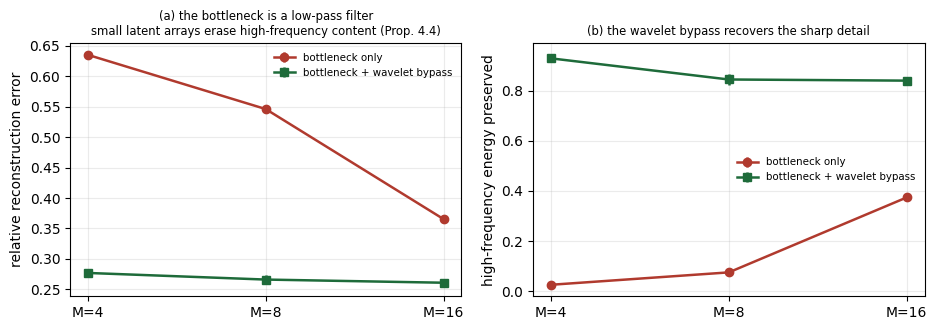
The fixed-array bottleneck is a low-pass filter (2.6% of high-frequency energy survives at M=4); the wavelet bypass restores 93% and halves the error.
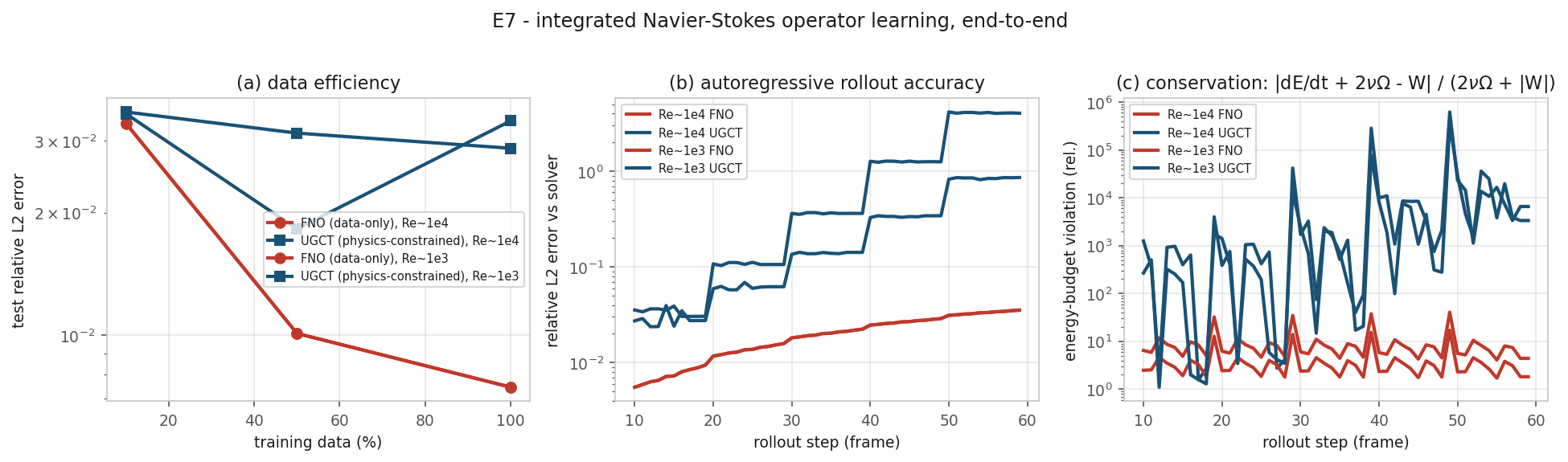
The integrated FNO backbone + NS-residual loss trains end-to-end on the canonical operator benchmark (64×64, Re ~ 1e4 & 1e3, frames 0–9 → 10–19): test rel. L2 0.007 (FNO) vs 0.029 (UGCT) at 100% data, with the exact discrete energy budget dE/dt = −2νΩ + W measured on 50-step rollouts — violated ~10³–10⁴× by learned rollouts even when pointwise error is small.
Key numbers
Every number on this page that is not a schematic traces to a committed script in experiments/ with committed JSON results in experiments/results/.
| experiment | measure | predicted failure | with fix | takeaway |
|---|---|---|---|---|
| E1 frame selection rotating cloud | max latent jump | 2.00 snap (3.4% of steps) | 0.00 | argmax frames snap at symmetry crossings; continuous expectation glides |
| E2 gradient surgery coupled field, anti-parallel residuals | coupled-update norm | 0.000 — PCGrad and NashMTL freeze the shared physics (dist to compromise stuck at 1.0) | 0.048 — plain SGD moves; dist 1.0 → 0.51 | the gradient-surgery fixes fail exactly on coupled variables: null-space trap (Prop.) and infeasible-bargaining deadlock; the scalarized sum still works |
| E3 conservation 1,000-step advection, subdomains | spurious source / mass drift | 8.90 / −0.88% | 0.00 / 0.0% | naive stitching leaks at every artificial interface; the FVM flux lock is exactly conservative |
| E4 mesh independence operator trained at N=16 | rel. L2 at N=16/64/128 | 0.039 @ N=16, locked (MLP) | 0.0069 @ all N (FNO) | the operator backbone transfers zero-shot to any grid; the token-based baseline cannot |
| E5 domain randomization randomized advection–diffusion | zero-shot MSE | 5.55 out-of-range (unmodeled wall) | 0.060 in-range; PID 0.875 → 0.115 | randomization covers what it models; PID is the bounded control anchor that corrects the rest |
| E6 wavelet bypass M=4 Fourier bottleneck, shocks | high-frequency energy kept | 2.6% | 93% (err 0.635 → 0.277) | the fixed latent array is a low-pass filter; the dyadic wavelet bypass restores the sharp detail |
| E7 end-to-end NS 64×64, Re ~ 1e4 & 1e3, FNO + NS loss | test rel. L2 / energy-budget violation | soft residual provides no data-efficiency gain (UGCT 0.031 vs FNO 0.010 @ 50% data) | integrated system trained end-to-end on the canonical benchmark; exact budget dE/dt = −2νΩ + W measured on 50-step rollouts | the residual term neither helps data efficiency nor stabilizes prediction (UGCT rollout compounds 0.027 → 0.86); budget violated 10³–10⁴× even when pointwise error is small — the motivation for the paper's conservation hardlocks |
Reproduce
git clone https://github.com/sehajr-singhs/ugct
cd ugct
pip install -r requirements.txt

# seven experiments: E1-E6 reproduce each failure mode + its fix,
# E7 trains the integrated system end-to-end on the NS operator benchmark
cd experiments
python frame_continuity.py       # E1: frame snaps vs continuous expectation
python gradient_surgery_physics.py  # E2: PCGrad null-space trap vs Nash deadlock
python conservation_rollout.py   # E3: boundary leaks vs the FVM flux lock
python mesh_independence.py      # E4: FNO zero-shot mesh transfer
python domain_randomization.py   # E5: randomization + PID control anchor
python wavelet_bypass.py         # E6: low-pass bottleneck vs wavelet bypass

# regenerate every schematic figure (paper/figures and figs/)
cd ../paper
python make_figures.py

# compile the papers (LaTeX sources in paper/)
pdflatex main && bibtex main && pdflatex main && pdflatex main
pdflatex ieee && bibtex ieee && pdflatex ieee && pdflatex ieee
CPU-only, deterministic seeds, runs in seconds. The ugct/ package is a reference implementation of every component: frames, operators, losses, conservation, perceiver, wavelet, hodge, and the assembled four-tier pipeline.