The tensor pipeline extends to 2D fields: the same transformer with a field-shaped head learns the full u(x, y) surface of a heat plate. The showcase number — 5.9% peak field error — is real and is the easiest member of the validation distribution, whose honest mean is ~29%; this paper reports the distribution, not just the showcase. Enforcing the Poisson residual cuts it 6–8× while field fidelity degrades: consistency is not accuracy at the field level. Against a per-instance PINN (DeepXDE, ~19 minutes per problem), the specialist wins on its own instance at 0.03–0.06% error but with a higher governing-equation residual; the generalist answers any instance in one forward pass. Both statements are true; the claim is the tradeoff.
The distribution, not the showcase
Papers that report only the showcase are reporting selection. The canonical plate is the easiest member of its own validation distribution; this paper commits the distribution and the code that draws from it.
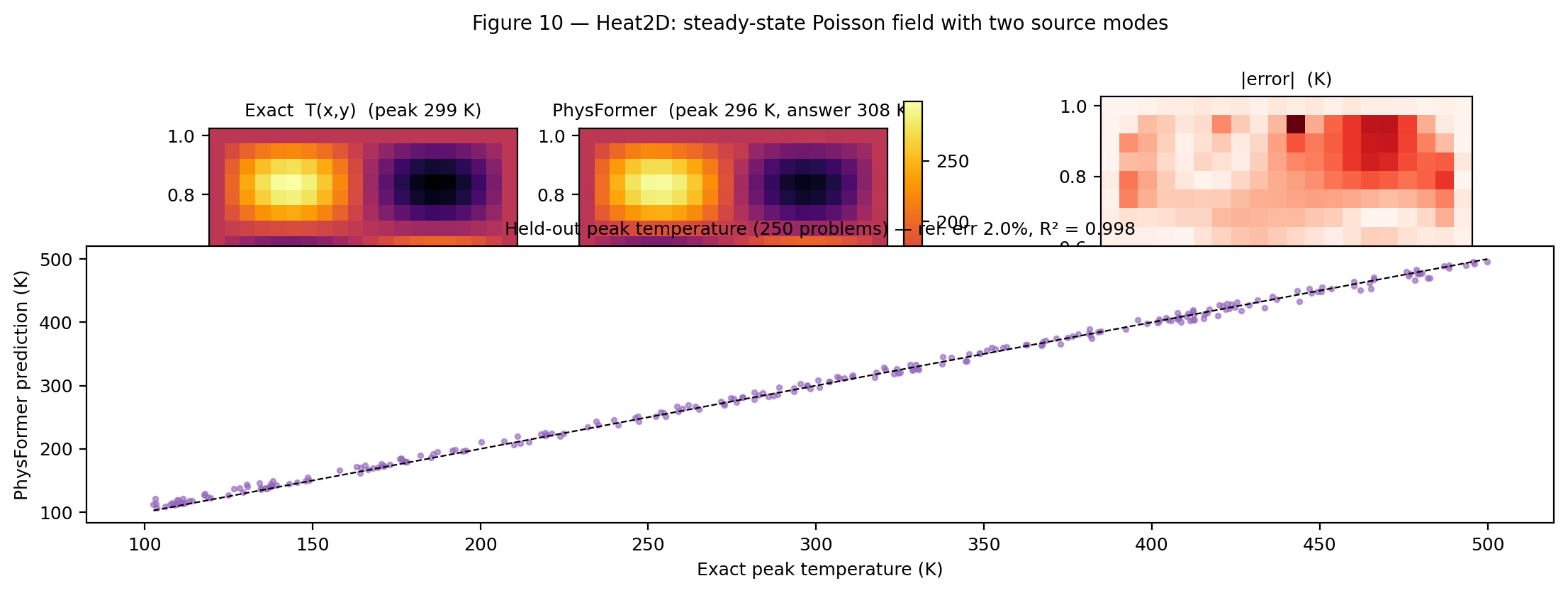
canonical peak field error vs the honest mean held-out peak error across the validation distribution — both measured, both reported.
the Poisson residual drops while field fidelity degrades: enforcing the equation makes predictions consistent, not correct.
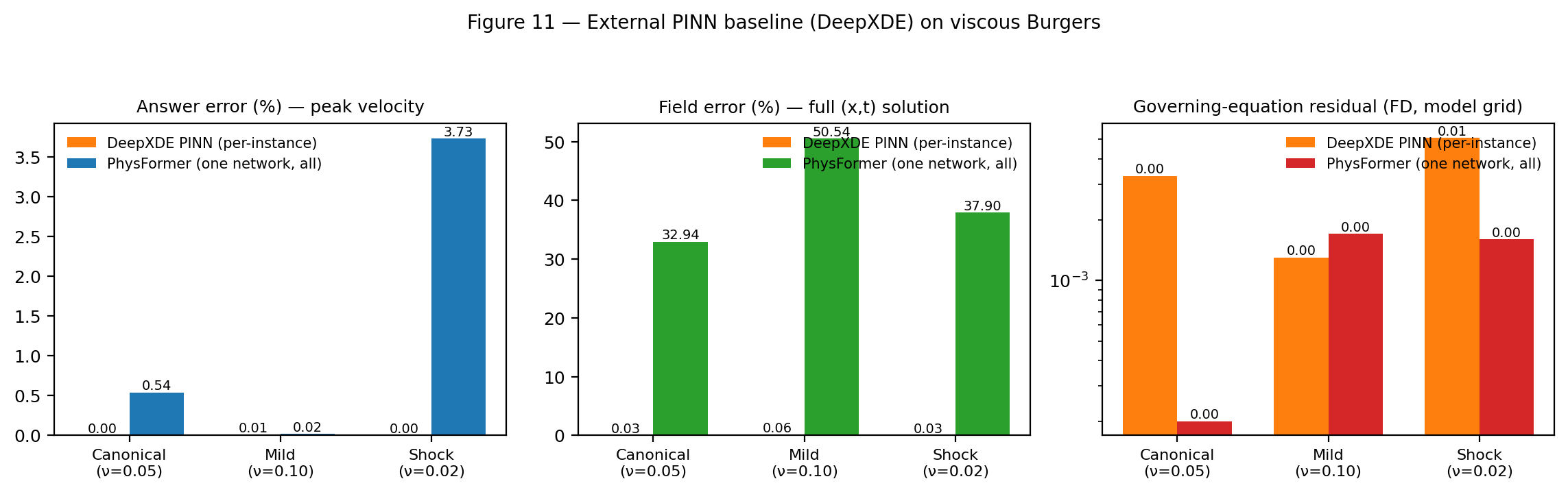
a per-instance DeepXDE PINN wins on its own problem; the generalist answers any instance in one forward pass with a lower governing-equation residual.
The DeepXDE comparison
On Burgers' equation, per-instance PINN (DeepXDE) reaches 0.03–0.06% full-field error on its own instance at ~19 minutes per problem; the single generalist answers any instance in one forward pass at 33–51% full-field error — but with a lower governing-equation residual (2×10⁻⁴ vs 1–5×10⁻³).
| Instance | DeepXDE (per-instance PINN) | generalist (one pass) |
|---|---|---|
| instances | — | — |
Reproduce
git clone https://github.com/sehajr-singhs/field-consistency
cd field-consistency
python -m unittest tests.test_physx        # 49 physics tests
python figs/make_figures.py                # figures from committed physvdata_data.json
python src/physx/run_physvdata.py          # re-run the field protocol
Simulation-only, CPU-scale, deterministic seeds. No GPU required.
Sister papers in the series
Seven manuscripts, one codebase, one guarantee: every number traces to a committed JSON and regenerates from a committed script.
the system and its project root
the PhysFormer architecture; the falsified regime theory
the 12-domain verifiable benchmark
the gate as the missing control in agent evaluation
when physics in the loss helps — and when it only enforces consistency
transfer across laws: what carries the knowledge